MCQ
The angle between the vectors $(\hat i + \hat j)$ and $(\hat j + \hat k)$ is ....... $^o$
  • A
    $30$
  • B
    $45$
  • $60$
  • D
    $90$

Answer

Correct option: C.
$60$
c
(c) $(\hat i + \hat j).(\hat j + \hat k) = 0 + 0 + 1 + 0 = 1$

$\cos \theta = \frac{{\vec A.\vec B}}{{|\vec A||\vec B|}} = \frac{1}{{\sqrt 2 \times \sqrt 2 }} = \frac{1}{2}$ 

$\theta = 60^\circ $

Need a full question paper?

Generate a complete, print-ready paper with questions like this in minutes — across 16+ boards, with answer keys.
Start Generating Free

Similar questions

A barometer tube reads $ 76 cm $ of mercury. If the tube is gradually inclined at an angle of $ 60°$  with vertical, keeping the open end immersed in the mercury reservoir, the length of the mercury column will be ........ $cm$
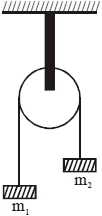
A uniformly thick wheel with moment of inertia $I$ and radius $R$ is free to rotate about its centre of mass (see fig). A massless string is wrapped over its rim and two blocks of masses $\mathrm{m}_{1}$ and $\mathrm{m}_{2}\left(\mathrm{m}_{1}>\mathrm{m}_{2}\right)$ are attached to the ends of the string. The system is released from rest. The angular speed of the wheel when $\mathrm{m}_{1}$ descents by a distance $h$ is
A particle moves with constant angular velocity in circular path of certain radius and is acted upon by a certain centripetal force $F$. If the angular velocity is doubled, keeping radius the same, the new force will be
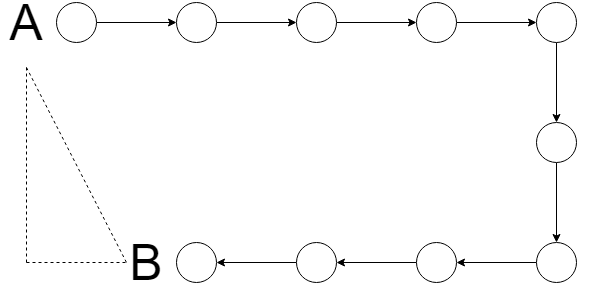
If, in the following diagram, distance between each circle is 1 unit, what is the displacement between A and B?

The density of a substance at 0°C is 10g/cc and at 100°C, its density is 9.7g/cc. The coefficient of linear expansion of the substance is:
A particle executing $S.H.M.$ of amplitude 4 cm and $T = 4 \,sec.$ The time taken by it to move from positive extreme position to half the amplitude is ..... $\sec$
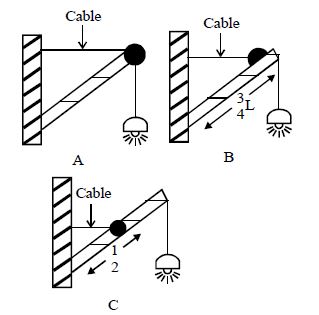
If a street light of mass $M$ is suspended from the end of a uniform rod of length $L$ in different possible patterns as shown in figure, then
A body of mass $2\,kg$ is moving with velocity $10 \,m/s$ towards east. Another body of same mass and same velocity moving towards north collides with former and coalsces and moves towards north-east. Its velocity is
What will be the work done in increasing the radius of soap bubble from $\frac{r}{2}$ to $2 r$, if surface tension of soap solution is $T$ ?
A boy throws a ball with a velocity $u$ at an angle $\theta$ with the horizontal. At the same instant he starts running with uniform velocity to catch the ball before if hits the ground. To achieve this he should run with a velocity of