MCQ
The angle of incidence at which reflected light is totally polarized for reflection from air to glass (refractive index n), is
  • A
    $sin^{-1} (n)$
  • B
    ${\sin ^{ - 1}}\,\left( {\frac{1}{n}} \right)$
  • C
    ${\tan ^{ - 1}}\left( {\frac{1}{n}} \right)$
  • $tan^{-1}\, (n)$

Answer

Correct option: D.
$tan^{-1}\, (n)$
d
બ્રુસ્ટર નો નિયમ  $ \mu  = tan\, i_p$

Need a full question paper?

Generate a complete, print-ready paper with questions like this in minutes — across 16+ boards, with answer keys.

Start Generating Free

Similar questions

An emf of $20\; \mathrm{V}$ is applied at time $\mathrm{t}=0$ to a circuit containing in series $10\; \mathrm{mH}$ inductor and $5 \;\Omega$ resistor. The ratio of the currents at time $\mathrm{t}=\infty$ and at $t=40\; s$ is close to : (Take $e^{2}=7.389$ )
Two coil $A$ and $B$ have coefficient of mutual inductance $M = 2H$. The magnetic flux passing through coil $A$ changes by $4$ Weber in $10$ seconds due to the change in current in $B$. Then
Assertion : In a simple battery circuit the point of lowest potential is positive terminal of the battery
Reason : The current flows towards the point of the higher potential as it flows in such a circuit from the negative to the positive terminal.
A uniformly charged solid sphere of radius $R$ has potential $V_0$ (measured with respect to $\infty$) on its surface. For this sphere the equipotential surfaces with potentials $\frac{{3{V_0}}}{2},\;\frac{{5{V_0}}}{4},\;\frac{{3{V_0}}}{4}$ and $\frac{{{V_0}}}{4}$ have rasius $R_1,R_2,R_3$ and $R_4$ respectively. Then
Unpolarized light of intensity $I$ passes through an ideal polarizer $A$ Another indentical polarizer $B$ is placed behind $A$ The intensity of light beyond $B$ is found to be $\frac{I}{2}$ Now another identical polarizer $C$ is placed between $A$ and $B$. The intensity beyond $B$ is now found to be $\frac{I}{8}$ The angle between polarizer $A$ and $C$ is:......$^o$
If potential (in volts) in a region is expressed as $V (x,y,z) =6xy-y+2yz $ the electric field (in $N/C$) at point $(1, 1, 0)$ is 
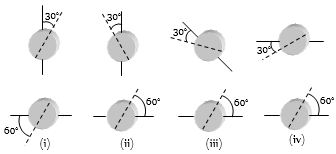
The figure shows four pairs of polarizing sheets, seen face-on. Each pair is mounted in the path of initially unpolarized light. The polarizing direction of each sheet (indicated by the dashed line) is referenced to either a horizontal $x$ - axis or $a$ vertical $y$ axis. Rank the pair according to the fraction of the initial intensity that they pass, greatest first
An N-type and P-type silicon can be obtained by doping pure silicon with
Let $\rho (r) =\frac{Q}{{\pi {R^4}}}r$ be the charge density distribution for a solid sphere of radius $R$ and total charge $Q$. For a point '$p$' inside the sphere at distance $r_1$ from the centre of the sphere, the magnitude of electric field is
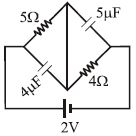
Find the ratio of energy stored in $5\,\mu F$ and $4\,\mu F$ capacitor in the given circuit in steady state