Question
The angular dispersion produced by a prism:
  1. Increases if the average refractive index increases.
  2. Increases if the average refractive index decreases.
  3. Remains constant whether the average refractive index increases or decreases.
  4. Has no relation with average refractive index.

Answer

  1. Increases if the average refractive index increases.

Explanation:

If $\mu$ is the average refractive index and A is the angle of prism, then the angular dispersion produced by the prism is given by $\delta=(\mu-1)\text{A}.$

Need a full question paper?

Generate a complete, print-ready paper with questions like this in minutes — across 16+ boards, with answer keys.

Start Generating Free

Similar questions

If copper wire is stretched to make its radius decrease by 0.1%, then the percentage change in its resistance is approximately

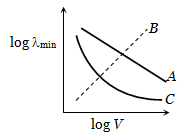
The dependence of the short wavelength limit   on the accelerating potential V is represented by the curve of figure

(a) A 

(b) B 

(c) C 

(d) None of these

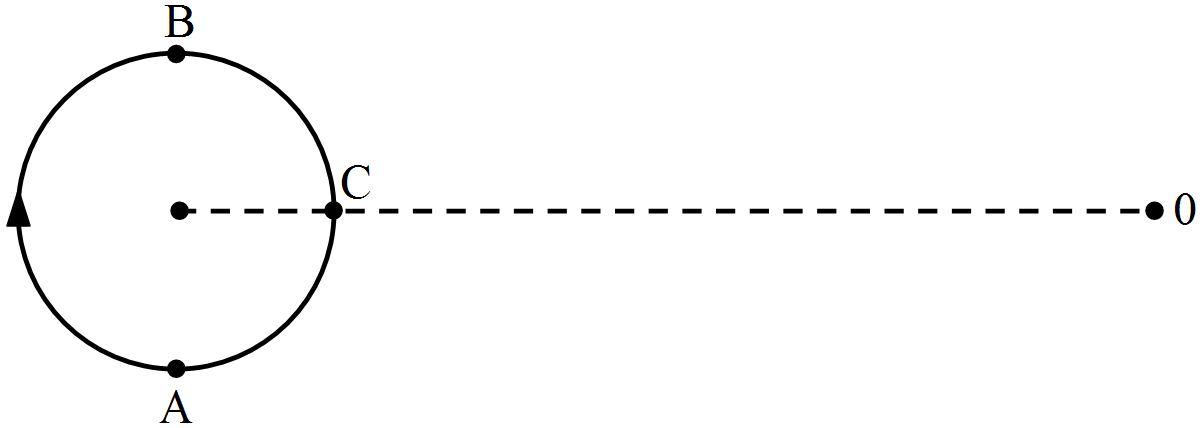
A small source of sound moves on a circle as shown-in figure and an observer is sitting at 0. Let v1, v2, v3 be the frequencies heard when the source is at A, B and C respectively.

  1. v1 > v2 > v3

  2. v1 = v2 > v3

  3. v2 > v3 > v1

  4. v1 > v2 > v2.

What is the amount of work done to bring a charge of 4 × 10-3C charge from infinity to a point whose electric potential is 2 × 102V?

An ideal transformer has 500 and 5000 turn in primary and secondary windings respectively. If the primary voltage is connected to a 6V battery then the secondary voltage is

(a) 0

(b) 60 V

(c) 0.6 V

(d) 6.0 V

Consider the following two statements:
  1. Line spectra contain information about atoms.
  2. Band spectra contain information about molecules.
  1. Both A and B are wrong
  2. A is correct but B is wrong.
  3. B is correct but A is wrong
  4. Both A and B are correct.
A galvanometer of resistance 25Ω galvanometer is given by a 2.5Ω wire. The part of total current $I _0$ that flows through the galvanometer is given by
Potential energy of a charged conductor is :

Curie-Weiss law is obeyed by iron at a temperature ......

(a) Below Curie temperature

(b) Above Curie temperature

(c) At Curie temperature only

(d) At all temperatures

The thermocouple is based on the principle of

(a) Seebeck effect

(b) Thomson effect

(c) Peltier effect

(d) Joule effect