MCQ
The angular momentum of an electron in an orbit is quantized because it is a necessary condition for the compatibility with:
- AWave nature of electron
- BParticle nature of electron
- CPauli's exclusion behaviour
- DNone of these
Explanation:
Quantization of angular momentum comes from the particle nature of electrons, and all of its postulates.
Generate a complete, print-ready paper with questions like this in minutes — across 16+ boards, with answer keys.
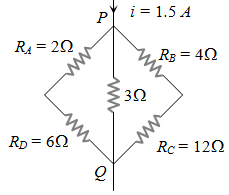
Potential difference between the points P and Q in the electric circuit shown is
|
(a) 4.5 V |
(b) 1.2 V |
(c) 2.4 V |
(d) 2.88 V |
A normal eye is not able to see objects closer than 25cm because:
The magnetic field due to the earth is closely equivalent to that due to
|
(a) A large magnet of length equal to the diameter of the earth |
| (b) A magnetic dipole placed at the centre of the earth |
| (c) A large coil carrying current |
| (d) Neither of the above |
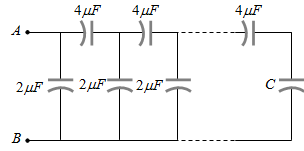
A finite ladder is constructed by connecting several sections of 2μF,4 μF capacitor combinations as shown in the figure. It is terminated by a capacitor of capacitance C. What value should be chosen for C such that the equivalent capacitance of the ladder between the points A and B becomes independent of the number of sections in between
|
(a) 4μF |
(b) 2 μF |
(c) 18 μF |
(d) 6 μF |
A bar magnet of magnetic moment 200 A-m2 is suspended in a magnetic field of intensity 0.25 N/A-m. The couple required to deflect it through 30o is
|
(a) 50 N-m |
(b) 25 N-m |
(c) 20 N-m |
(d) 15 N-m |
The velocity of photon is proportional to (where n is frequency)
|
(a) |
(b) |
(c) |
(d) n |
An electron of mass m and charge e is accelerated from rest through a potential difference V in vacuum. The final speed of the electron will be
|
(a) |
(b) |
(c) |
(d) 2eV/m |


