MCQ
The angular width of the central maximum in a single slit diffraction pattern is $60^o $ . The width of the slit is $1\ \mu m$. The slit is illuminated by monochromatic plane waves. If another slit of same width is made near it, Young's fringes can be observed on a screen placed at  distance $50\ cm$ from the slits. If the observed fringe width is $1\ cm$, what is slit separation distance?.........$\mu m$
(i.e. distance between the centres of each slit. )
  • A
    $50$ 
  • B
    $75 $ 
  • C
    $100$ 
  • $25$

Answer

Correct option: D.
$25$
d
Angular width of central maxima $=\frac{2 \lambda}{\mathrm{d}}$

or, $\lambda=\frac{\mathrm{d}}{2} ;$ Fringe width, $\beta=\frac{\lambda \times \mathrm{D}}{\mathrm{d}^{\prime}}$

$10^{-2}=\frac{d}{2} \times \frac{50 \times 10^{-2}}{d^{\prime}}=\frac{10^{-6} \times 50 \times 10^{-2}}{2 \times d^{\prime}}$

Therefore, slit separation distance, $\mathrm{d}^{\prime}=25 \,\mu \mathrm{m}$

Need a full question paper?

Generate a complete, print-ready paper with questions like this in minutes — across 16+ boards, with answer keys.

Start Generating Free

Similar questions

A teacher in his physics laboratory allotted an experiment to determine the resistance $(G)$ of a galvanometer. Students took the observations for $\frac{1}{3}$ deflection in the galvanometer. Which of the below is true for measuring value of $G$ $?$
Nuclear forces exists between:
Magnification produced by astronomical telescope for normal adjustment is $10$ and length of telescope is $1.1\, m$. The magnification when the image is formed at least distance of distinct vision $(D = 25\, cm)$ is
The electric potential between a proton and an electron is given by $V = {V_0}\ln \frac{r}{{{r_0}}},$ where ${r_0}$ is a constant. Assuming Bohr’s model to be applicable, write variation of ${r_n}$ with $n$, $n $ being the principal quantum number
Two lenses have focal lengths $f_1$ and $f_2$ and their dispersive powers are $\omega_1$ and $\omega_2$ respectively. They will together form an achromatic combination if
Assertion : If the temperature of a semiconductor is increased then it's resistance decreases.
Reason : The energy gap between conduction band and valence band is very small
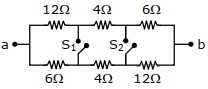
In the given figure switches $S_{1}$ and $S_{2}$ are in open condition. The resistance across $a b$ when the switches $S_{1}$ and $S_{2}$ are closed is $...\,\Omega$
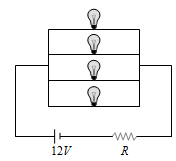
Four identical electrical lamps are labelled 1.5V, 0.5A which describes the condition necessary for them to operate at normal brightness. A 12V battery of negligible internal resistance is connected to lamps as shown, then

Which of the following statement is correct
In forward bias, the width of potential barrier in a P-N junction diode