MCQ
The animal which eats both plants and other animals is called $ ........... :$
  • A
    Autotrophic
  • B
    Herbivorous
  • C
    Carnivorous
  • Omnivorous

Answer

Correct option: D.
Omnivorous

Need a full question paper?

Generate a complete, print-ready paper with questions like this in minutes — across 16+ boards, with answer keys.
Start Generating Free

Similar questions

A student obtained a sharp image of a burning candle, placed at the farther end of a laboratory table, on a screen using a concave mirror. For getting better value of focal length of the mirror, the subject teacher suggested him for focusing a well illuminated distant object. What should the student do?
One of the following organisms has a saprophytic mode of nutrition. This organism is :
Which oxide will turn blue litmus solution to red?
$SO _2$
MgO
$Na _2 O$
$NO _2$
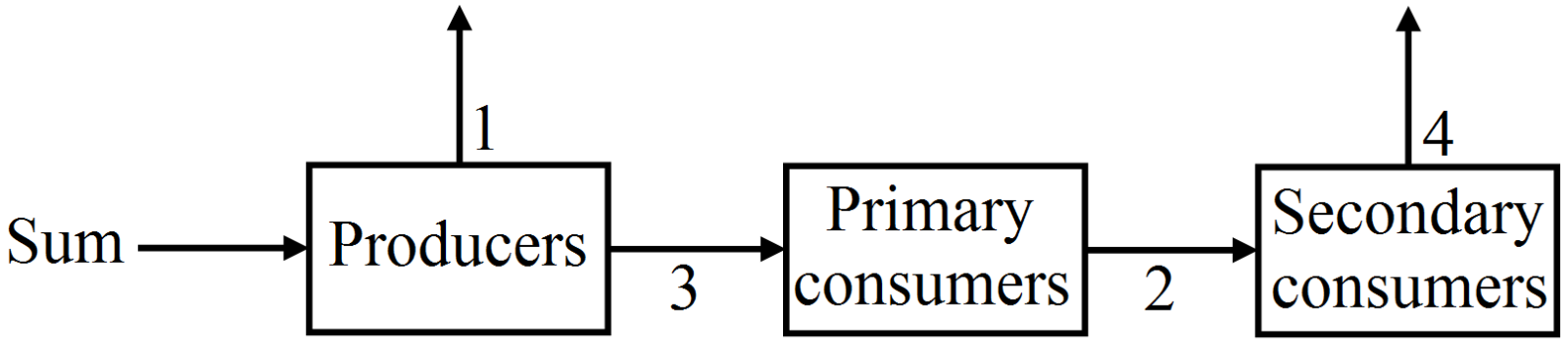
The diagram shots the flow of energy through an ecosystem.

The smallest amount of energy transferred between organisms and the largest amount of energy lost to the ecosystem is represented by which arrows?
  Smallest energy loss Largest energy loss
$(a)$ $4$ $3$
$(b)$ $2$ $1$
$(c)$ $2$ $3$
$(d)$ $1$ $4$
What is a result of natural selection?
The refractive index of glass for light going from air to glass is $\frac{3}{2}.$ The refractive index for light going from glass to air will be :
Which of the following statement(s) is (are) true about respiration?
i. During inhalation, ribs move inward and the diaphragm is raised
ii. In the alveoli, exchange of gases takes place i.e., oxygen from alveolar air diffuses into blood and carbon dioxide from the blood into the alveolar air
iii. Haemoglobin has a greater affinity for carbon dioxide than oxygen
iv. Alveoli increase surface area for exchange of gases
Which of the following pair of reactants can undergo a displacement reaction under appropriate conditions?
Sustainable development does not consider the view points of stakeholders.
One of the following acts as an endocrine gland as well as an exocrine gland. This one is :