MCQ
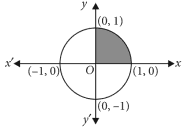
The area bounded by the curve $x^2+y^2=1$ in first quadrant is
  • $\frac{\pi}{4}$ sq. units
  • B
    $\frac{\pi}{2}$ sq. units
  • C
    $\frac{\pi}{3}$ sq. units
  • D
    $\frac{\pi}{6}$ sq. units

Answer

Correct option: A.
$\frac{\pi}{4}$ sq. units
(a): We have, $x^2+y^2=1$, which is a circle with centre $(0,0)$ and radius $=1$.
Image
Required area
$
\begin{array}{l}
=\int_0^1 \sqrt{1-x^2} d x \\
=\left[\frac{x}{2} \sqrt{1-x^2}+\frac{1}{2} \sin ^{-1} \frac{x}{1}\right]_0^1 \\
=\left[\frac{1}{2} \sin ^{-1} 1\right]=\left(\frac{1}{2} \times \frac{\pi}{2}\right)=\frac{\pi}{4} \text { sq. units }
\end{array}
$

Need a full question paper?

Generate a complete, print-ready paper with questions like this in minutes — across 16+ boards, with answer keys.

Start Generating Free

Similar questions

If A is a matrix of order 3 and |A| = 8, then |adj A| =
  1. 1
  2. 2
  3. 23
  4. 26
$\tan ^{-1}\left(\frac{1+\sqrt{3}}{3+\sqrt{3}}\right)+\sec ^{-1}\left(\sqrt{\frac{8+4 \sqrt{3}}{6+3 \sqrt{3}}}\right)$ is equal to $.........$
If $\left| {\begin{array}{*{20}{c}}
  {^9{C_4}}&{^9{C_5}}&{^{10}{C_r}} \\ 
  {^{10}{C_6}}&{^{10}{C_7}}&{^{11}{C_{r + 2}}} \\ 
  {^{11}{C_8}}&{^{11}{C_9}}&{^{12}{C_{r + 4}}} 
\end{array}} \right| = 0$ then $r$ is equal to 
Which of the following is true?
  1. * defined by $\text{a}*\text{b}=\frac{\text{a + b}}2$ is a binary operation on Z.
  2. * defined by $\text{a}*\text{b}=\frac{\text{a + b}}2$ is a binary operation on Q.
  3. All binary commutative operations are associative.
  4. Subtraction is a binary operation on N.
Let $\vec{a}=\hat{i}+\hat{j}+2 \hat{k}, \vec{b}=2 \hat{i}-3 \hat{j}+\hat{k}$ and $\overrightarrow{ c }=\hat{ i }-\hat{ j }+\hat{ k }$ be three given vectors. Let $\vec{v}$ be a vector in the plane of $\vec{a}$ and $\overrightarrow{ b }$ whose projection on $\overrightarrow{ c }$ is $\frac{2}{\sqrt{3}}$. If $\overrightarrow{ v } . \hat{ j }=7$, then $\overrightarrow{ v } \cdot(\hat{ i }+\hat{ k })$ is equal to
Let $f(x)=\left\{\begin{array}{cl}x^2 \sin \left(\frac{1}{x}\right) & , x \neq 0 \\ 0 & , x=0\end{array} ;\right.$ Then at $x=0$
Let $S_n=\sum_{k=1}^n \frac{n}{n^2+k n+k^2}$ and $T_n=\sum_{k=0}^{n-1} \frac{n}{n^2+k n+k^2}$ for $n=1,2,3, \ldots$ Then,

$(A)$ $\mathrm{S}_{\mathrm{n}}<\frac{\pi}{3 \sqrt{3}}$ $(B)$ $S_n>\frac{\pi}{3 \sqrt{3}}$

$(C)$ $T_n<\frac{\pi}{3 \sqrt{3}}$ $(D)$ $T_n>\frac{\pi}{3 \sqrt{3}}$

What is the value of $ \cos (2 \cos^{-1} 0.8)\cos(2\cos−10.8)?$
  1. 0.81
  2. 0.56
  3. 0.48
  4. 0.28
Consider the objective function Z = 40x + 50y The minimum number of constraints that are required to maximize Z are:
The value of the determinant $\left| {\,\begin{array}{*{20}{c}}a&{a\, + \,b}&{a\, + \,2b}\\{a\, + \,2b}&a&{a\, + \,b}\\{a\, + \,b}&{a\, + \,2b}&a\end{array}\,} \right|$ is