Question
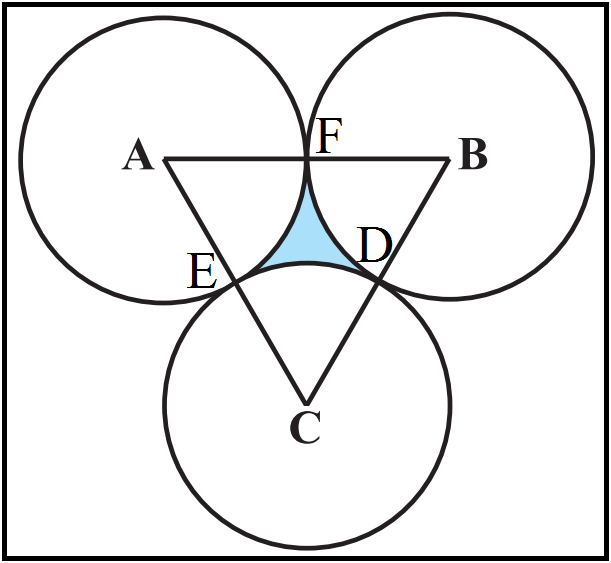
The area of an equilateral triangle is $49\sqrt{3}\text{cm}^2.$ taking each angular point as centre, circles are drawn with radius equal to half the length of the side of the triangle. Find the area of the triangle not included in the circles. $\big[\text{Take }\sqrt{3}=1.73\big]$
Answer

Area of equilateral triangle $\text{ABC}=49\sqrt{3}\text{cm}^2$

Let a be its side
$\therefore\frac{\sqrt{3}}{4}\text{a}^2=49\sqrt{3}$
Or $\text{a}^2=49\times4$
$\therefore\text{a}=7\times2$
$\Rightarrow\text{a}=14\text{cm}$
Area of sector $\text{BDF}=\pi\text{r}^2\times\frac{\theta}{360^\circ}$
$=\frac{22}{7}\times7\times7\times\frac{60}{360}\text{cm}$
$=\frac{11\times7}{3}\text{cm}^2=\frac{77}{3}\text{cm}^2$
Area pf sector $BDF =$ Area of sector $CDE =$ Area of sector $AEF$
Sum of area of all the sectors
$=\frac{77}{3}\times3\text{cm}^2=77\text{cm}^2$
$\therefore$ Shaded area = Area of $\triangle\text{ABC}$ - Sum of area of all sectors
$=49\sqrt{3}-77\text{cm}^2=(84.77-77.00)\text{cm}^2$
$=7.77\text{cm}^2$

Need a full question paper?

Generate a complete, print-ready paper with questions like this in minutes — across 16+ boards, with answer keys.

Start Generating Free

Similar questions

A bucket made up of a metal sheet is in the form of a frustum of a cone of height $16\ cm$ with diameters of its lower and upper ends as $16\ cm$ and $40\ cm$ respectively. Find the volume of the bucket. Also, find the cost of the bucket if the cost of metal sheet used in Rs. $20$ per $100\ cm^2$. $(\text{use}\ \pi=3.14)$
Solve graphically each of the following systems of linear equations. Also, find the coordinates of the points where the lines meet the axis of x in each system.
$x + 2y = 5,$
$2x - 3y = -4.$
A chord 10cm long is drawn in a circle whose radius is $5\sqrt{2}\text{cm}.$ Find area of both the segments.
Show graphically that each of the following given systems of equations is inconsistent, i.e., has no solutions:
$2x + y = 6, 6x + 3y = 20$
The radii of the circular bases of a frustum of a right circular cone are $12\ cm$ and $3\ cm$ and the height is $12\ cm$. Find the total surface area and the volume of the frustum.
The sum of a natural number and its square is $156$. Find the number.
Find the roots of the following quadratic equation (if they exist) by the method of completing the square.
$\sqrt{3}\text{x}^2+10\text{x}+7\sqrt{3}=0$
Three consecutive vertices of a parallelogram are $(-2, 1), (1, 0)$ and $(4, 3)$. Find the fourth vertex.
If $(\text{cosec}\theta+\cot\theta)=\text{m}$ and $(\text{cosec }\theta-\cot\theta)=\text{n},$ show that mn $= 1.$
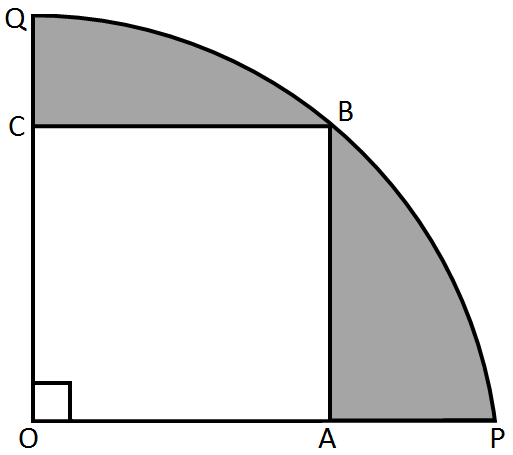
In the following figure a square $OABC$ is inscribed in a quadrant $OPBQ$ of a circle. If $OA = 21\ cm$, find the area of the shaded region.