MCQ
The atomic number of an element is always equal to
  • A
    Atomic weight divided by $2$
  • B
    Number of neutrons in the nucleus
  • C
    Weight of the nucleus
  • Electrical charge of the nucleus

Answer

Correct option: D.
Electrical charge of the nucleus
d
Atomic number $=$ number of protons.

Each proton has unit positive charge and hence, electrical charge of the nucleus is equal to the atomic number of the element.

Need a full question paper?

Generate a complete, print-ready paper with questions like this in minutes — across 16+ boards, with answer keys.

Start Generating Free

Similar questions

$1\,mol$ of oxygen gas are heated at constant volume from $20\,^oC$ to $30\,^oC$ . What will be change in the internal energy of gas? Molar heat capacity of oxygen at constant pressure, $ C_P= 7.03\,cal\,mol^{-1}\,K^{-1}$ and $R = 2\,cal\,mol^{-1}\,K^{-1}$ ? .....$cal$
White precipitate of $AgCl$ dissolves in aqueous ammonia solution due to formation of ..... .
Which one of the following is not an intermediate in the generally accepted  mechanism for the reaction shown below ?

$\begin{matrix}
   O\,\,\,\,\,\,\,\,\,\,\,\,\,\,\,\,\,\,\,\,\,\,\,\,\,\,\,\,\,\,\,\,\,\,\,\,\,\,  \\
   ||\,\,\,\,\,\,\,\,\,\,\,\,\,\,\,\,\,\,\,\,\,\,\,\,\,\,\,\,\,\,\,\,\,\,\,\,\,\,\,\,  \\
   C{{F}_{3}}\,C\,OH+C{{H}_{3}}\,CH\,C{{H}_{3}}  \\
   \,\,\,\,\,\,\,\,\,\,\,\,\,\,\,\,\,\,\,\,\,\,\,\,\,\,\,\,\,\,|  \\
   \,\,\,\,\,\,\,\,\,\,\,\,\,\,\,\,\,\,\,\,\,\,\,\,\,\,\,\,\,\,\,\,\,OH  \\
\end{matrix}\xrightarrow{{{H}_{2}}S{{O}_{4}}}\begin{matrix}
   O\,\,\,\,\,\,\,\,\,\,\,\,\,\,\,\,\,\,\,\,\,\,\,\,\,\,\,\,\,\,\,  \\
   ||\,\,\,\,\,\,\,\,\,\,\,\,\,\,\,\,\,\,\,\,\,\,\,\,\,\,\,\,\,\,\,\,\,  \\
   C{{F}_{3}}\,C\,OCH\,C{{H}_{3}}+{{H}_{2}}O  \\
   |\,\,\,\,\,\,\,\,\,\,\,\, \,\,\,\, \\
   C{{H}_{3}}\,\,\,\,\,\,\,\,\,\,\,  \\
\end{matrix}$

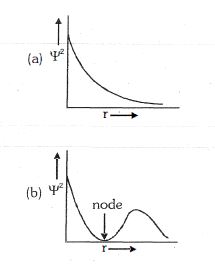
In following two plots, ${\psi ^2}$ is plotted against the distance $'r'$ from nucleus

select the correct statement

If an aqueous solution of glucoseis allowed to freeze than crystal of which will be separated out first
$A + CC{l_4} + KOH \to $ Salicylic acid 

$‘A’$  in above reaction is

Strong reducing behaviour of $H _{3} PO _{2}$ is due to
For any given series of spectral lines of atomic hydrogen, let $\Delta \bar V\, = \,\Delta {\bar V_{\max }}\, - \,\Delta {\bar V_{\min }}$ be the difference in maximum and minimum frequencies in $cm^{-1}.$ the ration $\Delta {\bar V_{Lymann}}/\,\Delta {\bar V_{Balmer}}$ is
Which of the following complexes will exhibit maximum attraction to an applied magnetic field?
In which of the following is the  $O-N-O$  bond angle highest ?