Question
The avalanche breakdown in p-n junction is due to:

Answer

  1. Cumulative effect of conduction band electron.
Explanation:
The avalanche breakdown in p-n junction is due to cumulative effect of conduction band electron. In reverse bias, due to applied electric field, electrons acquire enough energy to free more electron bound to the atom. The abundant number of electron-hole pairs are created for conduction, this is cumulative effect.

Need a full question paper?

Generate a complete, print-ready paper with questions like this in minutes — across 16+ boards, with answer keys.
Start Generating Free

Similar questions

Which one of the following device makes use of the electrons to strike certain substances to produce fluorescence?
The Boolean equation of $\text{NOR}$ gate is
An electric current i enters and leaves a uniform circular wire of radius a through diametrically opposite points. A charged particle q moving along the axis of the circular wire passes through its centre at speed v. The magnetic force acting on the particle when it passes through the centre has a magnitude:
  1. $\text{qv}\frac{\mu_0\text{i}}{2\text{a}}$
  2. $\text{qv}\frac{\mu_0\text{i}}{2\pi\text{a}}$
  3. $\text{qv}\frac{\mu_0\text{i}}{\text{a}}$
  4. $\text{Zero}$
Which instrument is used as the null detector in the Wheatstone bridge?
Which of the following mirrors always forms a virtual and small image?
Potential at a point $x-$distance from the centre inside the conducting sphere of radius $R$ and charged with charge $Q$ is
What will be the angular momentum of a electron, if energy of this electron in $H-$atom is $1.5eV ($in $J-\sec)$
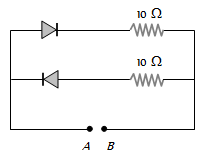
A $2V$ battery is connected across the points $A$ and $B$ as shown in the figure given below. Assuming that the resistance of each diode is zero in forward bias and infinity in reverse bias, the current supplied by the battery when its positive terminal is connected to $A$ is
X-rays are known to be electromagnetic radiations. Therefore the X-ray photon has (a) Electric charge(b) Magnetic moment(c) Both electric charge and magnetic moment(d) Neither electric charge nor magnetic moment


When a glass rod is rubbed with silk, what kind of charge will be developed on glass?