Question
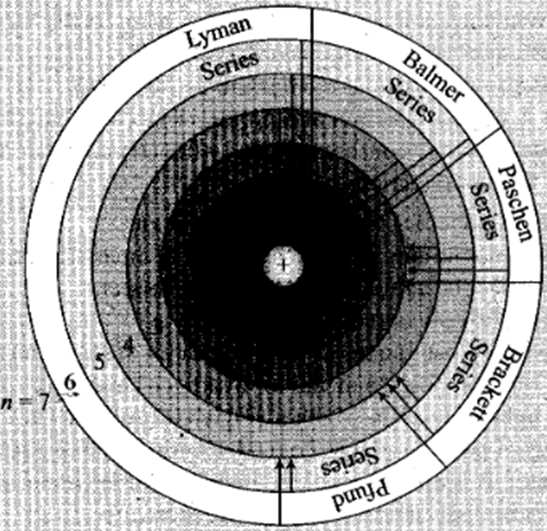
The Balmer series for the $H-$ atom can be observed:
Answer

If we measure the frequencies of light emitted due to transitions between excited states and the first excited state.
A​​​​s a sequence of frequencies with the higher frequencies getting closely packed.
Key concept :
​​​​​​​The vatious lines in the atomic spectra are produced when electrons jump fron higher energy state to a lower energy state and photons are emitted.
These spectral lines are called emission lines.
  1. Mainly there are five series and each series is named after its discoverer as Lyman series, Balmer series, Paschan series, Bracket series and Pfund series.
  2. According to the Bohr's theory the wavelength of the radiations emitted from hydrogen atom is given by
$\frac{1}{\lambda}=\text{R}\bigg[\frac{1}{\text{n}_1^2}-\frac{1}{\text{n}_2^2}\bigg]$
$\Rightarrow\ \lambda=\frac{\text{n}_1^2\text{n}_2^2}{(\text{n}_2^2-\text{n}_1^2)\text{R}}=\frac{\text{n}_1^2}{\Big(1-\frac{\text{n}_1^2}{\text{n}_2^2}\Big)\text{R}}$
where $n_2 =$ outer orbit $($electron jumps from this orbit$), n_1 =$ inner orbit $($electron falls in this orbit$)​​​​​​​$​​​​​​​
  1. First line of the series is called first member, for this lines wavelength is maximum $(\lambda_\text{max})$.
  2. For maximum wavelength if $n_1 = n,$ then $n_2 = n + 1.$
  3. So $\lambda_\text{max}=\frac{\text{n}^2(\text{n}+1)^2}{(2\text{n}+1)\text{R}}$.
  4. Last line of the series is called series limit, for this line wavelength is minimum $(\lambda_\text{max})$.
  5. Foe minimum wavelength $\text{n}_2=\infty,\text{n}_1=\text{n}.\text{ So}\lambda_\text{min}=\frac{\text{n}^2}{\text{R}}.$
  6. The radio of first member and series limit can be calculated as $\frac{\lambda_\text{max}}{\lambda_\text{min}}=\frac{(\text{n}+1)^2}{(2\text{n}+1)}$.
Different spectral series
 
Spectral Series
Transition
$\lambda_\text{max}$
$\lambda_\text{min}$
$\frac{\lambda_\text{max}}{\lambda_\text{min}}$
Region
$1.$
Lyman series
$\text{n}_2=2,3,4 \ ....\infty$
$\text{n}_1=1$
$\frac{4}{3\text{R}}$
$\frac{1}{\text{R}}$
$\frac{4}{3}$
Ultraviolet region
$2.$
Blamer series
$\text{n}_2=3,4,5 \ ....\infty$
$\text{n}_1=2$
$\frac{36}{5\text{R}}$
$\frac{4}{\text{R}}$
$\frac{9}{5}$
Visible region
$3.$
Paschen series
 
$\text{n}_2=4,5,6 \ ....\infty$
$\text{n}_1=3$
$\frac{144}{7\text{R}}$
$\frac{9}{\text{R}}$
$\frac{16}{7}$
Infrared region
$4.$
Bracket series
$\text{n}_2=5,6,7 \ ....\infty$
$\text{n}_1=4$
$\frac{400}{9\text{R}}$
$\frac{16}{\text{R}}$
$\frac{25}{9}$
Infrared region
$5.$
Pfund series
$\text{n}_2=6,7,8 \ ....\infty$
$\text{n}_1=5$
$\frac{900}{11\text{R}}$
$\frac{25}{\text{R}}$
$\frac{36}{11}$
Infrared region
From above discussion we can say Balmer series for the $H-$ atom can be observed if we measure the frequencies of light emitted due to transitions between higher excited states and the first excited state and as a sequence of frequencies with the higher frequencies getting closely packed.

Need a full question paper?

Generate a complete, print-ready paper with questions like this in minutes — across 16+ boards, with answer keys.

Start Generating Free

Similar questions

For P-type semiconductors, impurity elements are used :
A dip circle is so set that its needle moves freely in the magnetic meridian. In this position, the angle of dip is 40º. Now the dip circle is rotated so that the plane in which the needle moves makes an angle of 30º with the magnetic meridian. In this position, the needle will dip by an angle:
A voltmeter of resistance 1000 Ω  gives full scale deflection when a current of 100 mA flow through it. The shunt resistance required across it to enable it to be used as an ammeter reading 1 A at full scale deflection is(a) 10000 Ω(b) 9000 Ω(c) 222 Ω(d) 111 Ω
       
The specific charge of an electron is
Consider the following two statements:
  1. Line spectra contain information about atoms.
  2. Band spectra contain information about molecules.
  1. Both A and B are wrong
  2. A is correct but B is wrong.
  3. B is correct but A is wrong
  4. Both A and B are correct.
Which of the following statement is not correct about two parallel conductors carrying equal currents in the same direction?
Consider the following two statements:
  1. Linear momentum of the system remains constant.
  2. Centre of mass of the system remains at rest.
  1. ​​​​​​A implies B and B implies A.
  2. A does not imply B and B does not imply A.
  3. A implies B but B does not imply A.
  4. B implies A but A does not imply B.
In helium nucleus, there are(a) 2 protons and 2 electrons(b) 2 neutrons, 2 protons and 2 electrons(c) 2 protons and 2 neutrons(d) 2 positrons and 2 protons
   
   
Each plate of a parallel plate capacitor has a charge q on it. The capacitor is now connected to a batter. Now:
A metal surface of work function 1.07 eV is irradiated with light of wavelength 332 nm. The retarding potential required to stop the escape of photo-electrons is(a) 4.81 eV(b) 3.74 eV(c) 2.66 eV(d) 1.07 eV