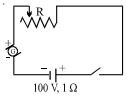
The battery in the diagram is to be charged by the generator $G$. The generator has a terminal voltage of $120$ $\mathrm{volts}$ when the charging current is $10$ $\mathrm{amperes}.$ The battery has an $\mathrm{emf}$ of $100$ $\mathrm{volts}$ and an internal resistance of $1$ $\mathrm{ohm}.$ In order to charge the battery at $10$ $\mathrm{amperes}$ charging current, the resistance $R$ should be set at ................ $\Omega$
Medium
Download our app for free and get started
The generator has a terminal voltage of $120$ volts when the charging current is $10$ amperes. Hence,
$E=V+I r=120+10(1)=130 \mathrm{V}$
Hence, in circuit
$R=\frac{E-V}{I}$
$R=\frac{130-120}{10}=1 \Omega$

Download our appand get started for free
Experience the future of education. Simply download our apps or reach out to us for more information. Let's shape the future of learning together!No signup needed.*
Similar Questions
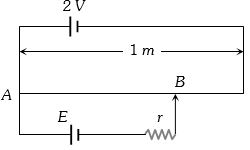
- 1In the given figure, battery $E $ is balanced on $55\, cm$ length of potentiometer wire but when a resistance of $10 \,\Omega$ is connected in parallel with the battery then it balances on $50\, cm$ length of the potentiometer wire then internal resistance $r$ of the battery is ............. $\Omega $View Solution
- 2View SolutionIn the experiment of potentiometer, at balance, there is no current in the
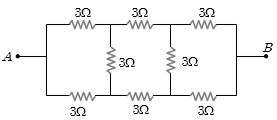
- 3Calculate the equivalent resistance between $A$ and $B$View Solution
- 4View SolutionSpecific resistance of a conductor increases with
- 5In the following $'I'$ refers to current and other symbols have their usual meaning, Choose the option that corresponds to the dimensions of electrical conductivityView Solution
- 6A storage battery is connected to a charger for charging with a voltage of $12.5\,\,Volts$. The internal resistance of the storage battery is $1\,\,\Omega$ . When the charging current is $0.5\,\,A$, the emf of the storage battery is: ............... $volts$View Solution
- 7View SolutionThe maximum current that flows through a fuse wire before it blows out varies with its radius as
- 8Three copper rods are subjected to different potential difference. Compare the drift speed of electrons through them. Assume that all $3$ are at the same temperature.View Solution
Length Diameter Potential difference $(A)$ $L$ $3d$ $V$ $(B)$ $2L$ $d$ $2V$ $(C)$ $3L$ $2d$ $2V$ - 9A current of $2\, mA$ was passed through an unknown resistor which dissipated a power of $4.4\, W$. Dissipated power when an ideal power supply of $11\, V$ is connected across it isView Solution
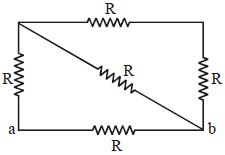
- 10Find out the equivalent resistance between the points $a$ and $b$View Solution