MCQ
The binding energy per nucleon for the parent nucleus is $E _1$ and for the decayed nuclei is $E _2$. Then :
- A$E _1=2 E _2$
- B$E _1> E _2$
- ✓$E _2> E$
- D$E _2=2 E _1$
Generate a complete, print-ready paper with questions like this in minutes — across 16+ boards, with answer keys.
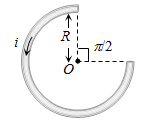
A current i ampere flows in a circular arc of wire whose radius is R, which subtend an angle 3π/2 radian at its centre. The magnetic induction B at the centre is
|
(a) |
(b) |
(c) |
(d) |
The electric intensity due to an infinite cylinder of radius R and having charge q per unit length at a distance r(r > R) from its axis is
|
(a) Directly proportional to |
(b) Directly proportional to |
|
(c) Inversely proportional to r |
(d) Inversely proportional to |
The resistance of a 5 cm long wire is 10 W. It is uniformly stretched so that its length becomes 20 cm. The resistance of the wire is
|
(a) 160 W |
(b) 80 W |
(c) 40 W |
(d) 20 W |
An inductance L and a resistance R are first connected to a battery. After some time the battery is disconnected but L and R remain connected in a closed circuit. Then the current reduces to 37% of its initial value in
|
(a) RL sec |
(b) |
(c) |
(d) |
In the figure, current through the 3 Ω resistor is 0.8 ampere, then potential drop through 4 Ω resistor is

|
(a) 9.6 V |
(b) 2.6 V |
(c) 4.8 V |
(d) 1.2 V |
The direction of induced e.m.f. during electromagnetic induction is given by
|
(a) Faraday's law |
(b) Lenz's law |
(c) Maxwell's law |
(d) Ampere's law |
Two unequal resistors are connected in series across a battery. Then the:


