MCQ
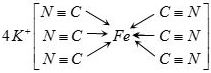
The bond in ${K_4}[Fe{(CN)_6}]$ are:
  • A
    All ionic
  • B
    All covalent
  • C
    Ionic and covalent
  • Ionic, covalent and co-ordiante covalent
Answer

Correct option: D.
Ionic, covalent and co-ordiante covalent
d
(d)

Need a full question paper?

Generate a complete, print-ready paper with questions like this in minutes — across 16+ boards, with answer keys.

Start Generating Free

Similar questions

The total number of species from the following in which one unpaired electron is present, is . . . . . . $\mathrm{N}_2, \mathrm{O}_2, \mathrm{C}_2^{-}, \mathrm{O}_2^{-}, \mathrm{O}_2^{2-}, \mathrm{H}_2^{+}, \mathrm{CN}^{-}, \mathrm{He}_2^{+}$
The hydrogen spectrum from an incadescent source of hydrogen is :
Consider the cell

$Pt _{( s )}\left| H _2( g , 1\,atm )\right| H ^{+}( aq , 1 M )|| Fe ^{3+}( aq ), Fe ^{2+}( aq ) \mid Pt ( s )$

When the potential of the cell is $0.712\,V$ at $298\,K$, the ratio $\left[ Fe ^{2+}\right] /\left[ Fe ^{3+}\right]$ is $.......$(Nearest integer)

Given: $Fe ^{3+}+ e ^{-}= Fe ^{2+}, E ^{\circ} Fe ^{3+}, Fe ^{2+} \mid Pt =0.771$

$\frac{2.303 RT }{ F }=0.06\,V$
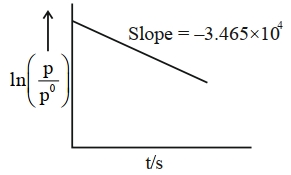
For the decomposition of azomethane. $CH _{3} N _{2} CH _{3}( g ) \rightarrow CH _{3} CH _{3}( g )+ N _{2}$ (g) a first order reaction, the variation in partial pressure with time at $600\,K$ is given as
$3\, moles$ of metal complex with formula $\mathrm{Co}(\mathrm{en})_{2} \mathrm{Cl}_{3}$ gives $3\, moles$ of silver chloride on treatment with excess of silver nitrate. The secondary valency of $Co$ in the complex is $.....$ (Round off to the nearest integer)
Among the following which one has the highest cation to anion size ratio ?
What is true about $H_2S_nO_6$ (Polythionic acid)
Write the $IUPAC$ name of  $\begin{array}{*{20}{c}}
  {\,\,\,\,H\,\,\,\,\,\,\,\,\,\,\,\,\,\,\,\,\,\,\,\,\,\,\,\,\,\,\,\,\,\,\,\,\,\,\,\,\,\,\,\,\,\,\,\,\,\,\,\,\,\,\,\,\,\,\,\,\,\,\,Br} \\ 
  {\,|\,\,\,\,\,\,\,\,\,\,\,\,\,\,\,\,\,\,\,\,\,\,\,\,\,\,\,\,\,\,\,\,\,\,\,\,\,\,\,\,\,\,\,\,\,\,\,\,\,\,\,\,\,\,\,\,\,\,\,\,\,\,\,\,\,|} \\ 
  {C{H_3} - C - C{H_2} - C{H_2} - C{H_2} - C - C{H_3}} \\ 
  {\,|\,\,\,\,\,\,\,\,\,\,\,\,\,\,\,\,\,\,\,\,\,\,\,\,\,\,\,\,\,\,\,\,\,\,\,\,\,\,\,\,\,\,\,\,\,\,\,\,\,\,\,\,\,\,\,\,\,\,\,\,\,\,\,\,\,\,|} \\ 
  {\,\,OH\,\,\,\,\,\,\,\,\,\,\,\,\,\,\,\,\,\,\,\,\,\,\,\,\,\,\,\,\,\,\,\,\,\,\,\,\,\,\,\,\,\,\,\,\,\,\,\,\,\,\,\,\,\,\,\,\,\,\,Br} 
\end{array}$
General configuration of outermost and penultimate shell is $(n - 1)\,{s^2}\,(n - 1)\,\,{p^6}(n - 1)\,\,{d^x}n{s^2}.$ If $n = 4$  and $ x = 5$  then no. of proton in the nucleus will be
For $K_3[Co(CN)_6]$, which of the following statement is not correct