MCQ
The bond order in $CO_3^{2 - }$ ion between $C - O$ is
  • A
    $0$
  • B
    $0.88$
  • $1.33$
  • D
    $2$

Answer

Correct option: C.
$1.33$
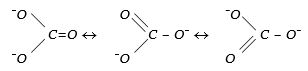
(c) We know that carbonate ion has following resonating structures

Bond order $ = \frac{{{\rm{Total \,number\,of \,bonds \,between \,atoms}}}}{{{\rm{Total\, number\, of \,resonating \,structure}}}}$

$ = \frac{{1 + 1 + 2}}{3} = \frac{4}{3} = 1.33$.
Need a full question paper?

Generate a complete, print-ready paper with questions like this in minutes — across 16+ boards, with answer keys.
Start Generating Free

Similar questions

$2-$ Hexyne gives trans $-2-$ Hexene on treatment with :
Which of the following elements in an organic compound cannot be detected by Lassaigne's test?
Which of the following is a polar compound
For any given series of spectral lines of atomic hydrogen, let $\Delta \bar V\, = \,\Delta {\bar V_{\max }}\, - \,\Delta {\bar V_{\min }}$ be the difference in maximum and minimum frequencies in $cm^{-1}.$ the ration $\Delta {\bar V_{Lymann}}/\,\Delta {\bar V_{Balmer}}$ is
In which of following reaction $K_p > K_c$ at $10\  K$ temperature
Which of the following is most reactive towards electrophile.
When sodium propionate is heated with soda lime, the product formed is :
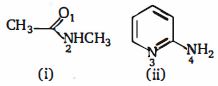
The preferred sites of protonation in the following compounds are
Consider a reversible reaction $2A + B \rightleftharpoons 2C$ having equilibrium constant $25$. If a reaction vessel having $2, 0.25$ and $0.5\, mol$ of $A, B$ and $C$ respectively in $100\, L$ vessel than what will be direction of reaction ?
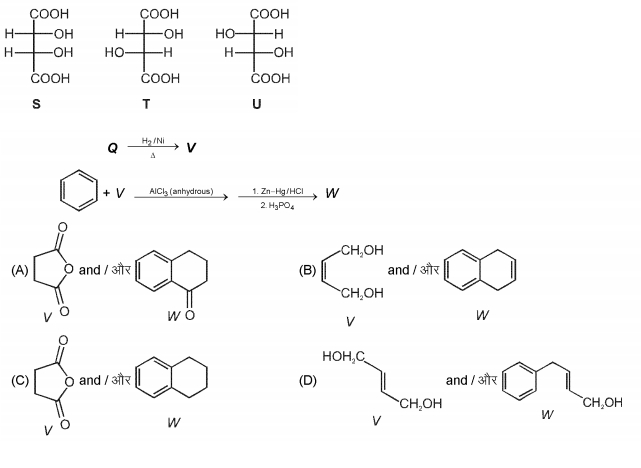
$P$ and $Q$ are isomers of dicarboxylic acid $C _4 H _4 O _4$. Both decolorize $Br _2 / H _2 O$. On heating, $P$ forms the cyclic anhydride.

Upon treatment with dilute alkaline $KMnO _4, P$ as well as $Q$ could produce one or more than one from $S , T$ and $U$.$Image$

$1.$ Compounds formed form $P$ and $Q$ are, respectively

$(A)$ Optically active $S$ and optically active pair $(T, U)$

$(B)$ Optically inactive $S$ and optically inactive pair $(T, U)$

$(C)$ Optically active pair $(T, U)$ and optically active $S$

$(D)$ Optically inactive pair $(T, U)$ and optically inactive $S$

$2.$ In the following reaction sequences $V$ and $W$ are respectively :$Image$

mcq $Image$

Give the answer question $1$ and $2.$