Question
The bottom of a ship is made heavy. Why?

Answer

The bottom of a ship is made heavy so that its centre of gravity remains low. This ensures the stability of its equilibrium.

Need a full question paper?

Generate a complete, print-ready paper with questions like this in minutes — across 16+ boards, with answer keys.
Start Generating Free

Similar questions

Define centripetal force. A cyclist speeding at 18km/ hr on a level road takes a sharp circular turn of radius 3m without reducing the speed. The coefficient of static friction is 0.1. Will the cyclist slip while taking the turn?
Explain the property of two vectors A and B if |A + B| = |A - B|.
A constant torque of 1000Nm turns a wheel of moment of inertia $200kgm^2$ about an axis through its centre. What is angular velocity after 3 seconds.
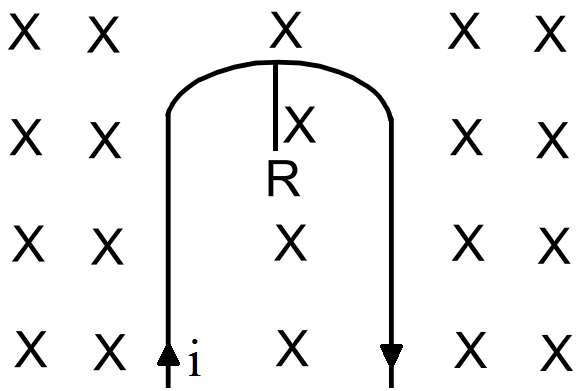
A rigid wire consists of a semi-circular portion of radius R and two straight sections The wire is partially immersed in a perpendicular magnetic field B, as shown in the figure. Find the magnetic force on the wire if it carries a current i.
Why is the value of $C _{ P }$ greater than $C _{ v }$ ?
A child blows air at one end of a straw and slowly cuts pieces of the straw from the other end. What will be the outcome that will be observed?
A block suspended from a vertical spring is in equilibrium. Show that the extension of the spring equals the length of an equivalent simple pendulum i.e., a pendulum having frequency same as that of the block.
Give the magnitude and direction of the net force acting on a stone of mass 0.1kg, (Neglect air resistance throughout.) Just after it is dropped from the window of a train running at a constant velocity of 36km/h.
If the initial velocity of a particle is $u$ and the acceleration in the same direction changes with time as $\alpha t$, then what will be the velocity at time $t$ ?
A cricket ball is thrown at a speed of $28\ m s ^{-1}$ in a direction $30$ above the horizontal. Calculate $(a)$ the maximum height, $(b)$ the time taken by the ball to return to the same level, and $(c)$ the distance from the thrower to the point where the ball returns to the same level.