MCQ
The $C-H$ bond distance is longest in
  • A
    ${C_2}{H_2}$
  • B
    ${C_2}{H_4}$
  • ${C_2}{H_6}$
  • D
    ${C_6}{H_6}$

Answer

Correct option: C.
${C_2}{H_6}$
(c) Single bond has longest distance of bonds so ${C_2}{H_6}$ ethane is correct answer.

Need a full question paper?

Generate a complete, print-ready paper with questions like this in minutes — across 16+ boards, with answer keys.

Start Generating Free

Similar questions

Combustion of $1$ mole of benzene is expressed at

$\mathrm{C}_6 \mathrm{H}_6(1)+\frac{15}{2} \mathrm{O}_2(\mathrm{~g}) \rightarrow \mathrm{CO}_2(\mathrm{~g})+3 \mathrm{H}_2 \mathrm{O}(1) \text {. }$

The standard enthalpy of combustion of $2 \mathrm{~mol}$ of benzene is - ' $x$ ' $k J$.

$\mathrm{x}=$. . . . . . . . . .

$(1)$ standard Enthalpy of formation of $1 \mathrm{~mol}$ of $\mathrm{C}_6 \mathrm{H}_6(1)$, for the reaction $6 \mathrm{C}$ (graphite) $+3 \mathrm{H}_2(\mathrm{~g}) \rightarrow \mathrm{C}_6 \mathrm{H}_n(1)$ is $48.5 \mathrm{~kJ} \mathrm{~mol}^{-1}$.

$(2)$ Standard Enthalpy of formation of $1 \mathrm{~mol}$ of $\mathrm{CO}_2(\mathrm{~g})$, for the reaction $\mathrm{C}$ (graphite) $+\mathrm{O}_{2(\mathrm{~g})} \rightarrow \mathrm{CO}_2(\mathrm{~g})$ is $-393.5 \mathrm{~kJ} \mathrm{~mol}^{-1}$.

$(3)$ Standard and Enthalpy of formation of $1 \mathrm{~mol}$ of $\mathrm{H}_2 \mathrm{O}(1)$, for the reaction $\mathrm{H}_2(\mathrm{~g})+\frac{1}{2} \mathrm{O}_2(\mathrm{~g}) \rightarrow \mathrm{H}_2 \mathrm{O}(1)$ is $-286 \mathrm{~kJ} \mathrm{~mol}^{-1}$.
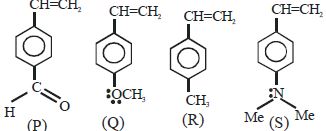
Which one amongst the following possesses an $sp$ hybridized carbon in its structure
Arrange the following compounds in decreasing order of rate of electrophilic addition reaction
When sodium peroxide is treated with dilute sulphuric acid, we get.
In thermodynamics which one of the following is not an intensive property
Select the compound from the following that will show intramolecular hydrogen bonding.
Which one of the following given graphs represents the variation of rate constant $(\mathrm{k})$ with temperature $(T)$ for an endothermic reaction ?
Which of the following will have the most negative and least negative electron gain enthalpy respectively, $\ce{P, S, Cl}$ and $\ce{F}\ ?$
The $IUPAC$ name of $\begin{matrix}
   C{{H}_{3}}-CH-C{{H}_{2}}-O-{{C}_{2}}{{H}_{5}}  \\
   |\,\,\,\,\,\,\,\,\,\,\,\,\,\,\,\,\,\,\,\,\,\,\,\,\,\,\,\,\,\,\,\,\,\,\,\,\,  \\
   OH\,\,\,\,\,\,\,\,\,\,\,\,\,\,\,\,\,\,\,\,\,\,\,\,\,\,\,\,\,\,\,\,\,  \\
\end{matrix}$ is
Which of the following has zero dipole moment