MCQ
The capacitance of each capacitor is $x$ in the given figure. Equivalence between points A and B will 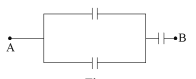
- A$3 x$
- B$\frac{x}{3}$
- ✓$\frac{2}{3} x$
- D$\frac{3}{2} x$
Generate a complete, print-ready paper with questions like this in minutes — across 16+ boards, with answer keys.
A single slit of width a is illuminated by violet light of wavelength 400 nm and the width of the diffraction pattern is measured as y. When half of the slit width is covered and illuminated by yellow light of wavelength 600 nm, the width of the diffraction pattern is
|
(a) The pattern vanishes and the width is zero |
(b) y / 3 |
|
(c) 3y |
(d) None of these |
Photons of energy 6 eV are incident on a metal surface whose work function is 4 eV. The minimum kinetic energy of the emitted photo-electrons will be
|
(a) 0 eV |
(b) 1 eV |
(c) 2 eV |
(d) 10 eV |
An electric dipole is placed in an electric field generated by a point charge
|
(a) The net electric force on the dipole must be zero |
|
(b) The net electric force on the dipole may be zero |
|
(c) The torque on the dipole due to the field must be zero |
|
(d) The torque on the dipole due to the field may be zero |
A single slit of width 0.20 mm is illuminated with light of wavelength 500 nm. The observing screen is placed 80 cm from the slit. The width of the central bright fringe will be
|
(a) 1 mm |
(b) 2 mm |
(c) 4 mm |
(d) 5 mm |
A substance is behaving as convex lens in air and concave in water, then its refractive index is
|
(a) Smaller than air |
(b) Greater than both air and water |
|
(c) Greater than air but less than water |
(d) Almost equal to water |
In N-type semiconductors, majority charge carriers are
|
(a) Holes |
(b) Protons |
(c) Neutrons |
(d) Electrons |
A photon of wavelength 4400 Å is passing through vacuum. The effective mass and momentum of the photon are respectively
|
(a) 5 |
(b) 5 |
|
(c) Zero, 1.5 |
(d) 5 |



