MCQ
The capacitive reactance in an $AC$ circuit is.
  • effective resistance due to capacity
  • B
    effective wattage
  • C
    effective voltage
  • D
    None of these

Answer

Correct option: A.
effective resistance due to capacity

Capacitive reactance in an $A.C$ circuit is: $\text{X}_\text{C}=\frac{1}{\omega\text{C}}\text{ohm}$
where, $C$ is the capacitance of capacitor and $\omega=2\pi\text{rn} (n$ is the frequency of $A.C$ source$)$

Need a full question paper?

Generate a complete, print-ready paper with questions like this in minutes — across 16+ boards, with answer keys.
Start Generating Free

Similar questions

In a semiconductor, the concentration of electrons is $8 \times {10^{14}}/c{m^3}$ and that of the holes is $5 \times {10^{12}}c{m^3}.$ The semiconductor is
In the Young’s double slit experiment with sodium light. The slits are 0.589 m a part. The angular separation of the third maximum from the central maximum will be (given ? = 589 mm) 
A proton is about 1840 times heavier than an electron. When it is accelerated by a potential difference of 1 kV, its kinetic energy will be
Consider a glass cube slab of dielectric bound by the planes $x=0, x=a ; y=0, y=b ; z=0, z=c$; with $b > a > c$. The slab is placed in air and has a refractive index of $n$. The minimum value for $n$, such that all rays entering the dielectric at $y=0$ reach $y=b$ is
When light is incident on a diffraction grating the zero order principal maximum will be
A convex lens is in contact with concave lens. The magnitude of the ratio of their focal length is $2/3.$ Their equivalent focal length is $30 cm.$ What are their individual focal lengths
The same radioactive nucleus may emit?
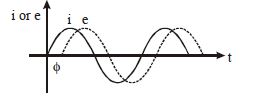
When an ac source of $e.m.f.\ e = E_0 sin(100t)$ is connected across a circuit, the phase difference between the $e.m.f.\ e$ and the current $i$ in the circuit is observed to be $\frac{\pi }{4}$ as shown in the diagram. If the circuit consists possibly only of $ RC$ or $ RL $ or $ LC$ in series, find the relationship between the two elements
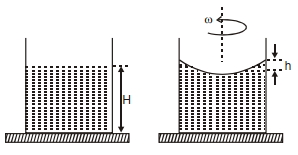
A beaker of radius $r$ is filled with water (refractive index $\frac{4}{3}$ ) up to a height $H$ as shown in the figure on the left. The beaker is kept on a horizontal table rotating with angular speed $\omega$. This makes the water surface curved so that the difference in the height of water level at the center and at the circumference of the beaker is $h(h \ll H, h \ll r)$, as shown in the figure on the right. Take this surface to be approximately spherical with a radius of curvature $R$. Which of the following is/are correct? ( $g$ is the acceleration due to gravity)

$(A)$ $R=\frac{h^2+r^2}{2 h}$

$(B)$ $R=\frac{3 r^2}{2 h}$

$(C)$ Apparent depth of the bottom of the beaker is close to $\frac{3 H }{2}\left(1+\frac{\omega^2 H }{2 g }\right)^{-1}$

$(D)$ Apparent depth of the bottom of the beaker is close to $\frac{3 H }{4}\left(1+\frac{\omega^2 H}{4 g }\right)^{-1}$
Hydrogen $(_1H^1),$ Deuterium $(_1H^2)$,singly ionised Helium $(_2He^4)^+$ and doubly ionised lithium ${\left( {{}_3^6Li} \right)^{ + + }}$, all have one electron around the nucleus. Consider an electron transition from $n = 2$ to $n = 1$. If the wavelengths of emitted radiation are $λ_1,λ_2,λ_3$ and $λ_4$ respectively then approximately which one of the following is correct?