Question

The capacitor of capacitance 4 μF  and 6 μF  are connected in series. A potential difference of  500 volts is applied to the outer plates of the two capacitor system. The potential difference across the plates of capacitor of 4 μF  capacitance is

(a) 500 volts

(b) 300 volts

(c) 200 volts

(d) 250 volts

Answer

(b) 300 volts

Need a full question paper?

Generate a complete, print-ready paper with questions like this in minutes — across 16+ boards, with answer keys.

Start Generating Free

Similar questions

Two capacitances of capacity  and  are connected in series and potential difference V is applied across it. Then the potential difference across  will be

(a)    

(b)  

(c)  

(d)  

The temperature of a solid object is observed to be constant during a period. In this period:
  1. Heat may have been supplied to the body.
  2. Heat may have been extracted from the body.
  3. No heat is supplied to the body.
  4. No heat ia ertracted from the body.

A logic gate is an electronic circuit which

(a) Makes logic decisions

(b) Allows electrons flow only in one direction

(c) Works binary algebra

(d) Alternates between 0 and 1 values

A cube of side l is placed in a uniform field E, where E = E. The net electric flux through the cube is

(a) Zero

(b)

(c) 4  

(d) 6 

The toroid of radius 10 cm has 100 turns. If a current of 0.1 ampere is flowing in it, then the value of the magnetic field on the axis of the toroid will be:

A wire in the form of a circular loop of one turn carrying a current produces a magnetic field B at the centre. If the same wire is looped into a coil of two turns and carries the same current, the new value of magnetic induction at the centre is

(a)  5B

(b) 3B

(c) 2B

(d) 4B

Magnitude of pursuit velocity does not depend on :
A capacitor becomes a perfect insulator for:
The potential difference between the two plates of a parallel plate capacitor is constant. When air between the plates is replaced by dielectric material, the electric field intensity:

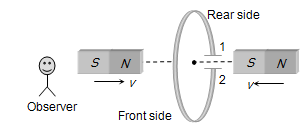
The north and south poles of two identical magnets approach a coil, containing a condenser, with equal speeds from opposite sides. Then

(a) Plate 1 will be negative and plate 2 positive

(b) Plate 1 will be positive and plate 2 negative

(c) Both the plates will be positive

(d) Both the plates will be negative