MCQ
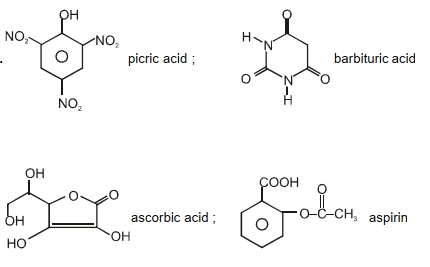
The carboxyl functional group $(- COOH )$ is present in
  • A
    picric acid
  • B
    barbituric acid
  • C
    ascorbic acid
  • aspirin

Answer

Correct option: D.
aspirin
d

Need a full question paper?

Generate a complete, print-ready paper with questions like this in minutes — across 16+ boards, with answer keys.

Start Generating Free

Similar questions

The electron affinity value are negative for :

$A$. $\mathrm{Be} \rightarrow \mathrm{Be}^{-}$

$B$. $\mathrm{N} \rightarrow \mathrm{N}^{-}$

$C$. $\mathrm{O} \rightarrow \mathrm{O}^{2-}$

$D$. $\mathrm{Na} \rightarrow \mathrm{Na}^{-}$

$E$. $\mathrm{Al} \rightarrow \mathrm{Al}^{-}$

Choose the most appropriate answer from the options given below :

Amongst the elements with following electronic configurations, which one of them may have the highest ionisation energy ?
Oxidation state of nitrogen is incorrectly given for

Compound $\to$ Oxidation state

Which of the following element does not show variable valency
Assign true $(T)$ or false $(F)$ for following statements and select correct option for your answer 

$(I)$ $I.P.$ of $O(g)$ is less than $I.P.$ of  $O_{\left( g \right)}^ - $

$(II)$ $I.P.$ of $Ne(g)$ is greater than $I.P$. of $Ne_{\left( g \right)}^ + $

$(III)$ $E.A.$ of $O_{\left( g \right)}^ + $ is greater than $E.A.$ of $O(g)$

$(IV)$ $I.P.$ of $N(g)$ is greater than $I.P.$ of $N_{\left( g \right)}^ + $

Reaction $2A + B \to$  product,  rate law is $\frac{{ - d[A]}}{{dt}}\, = \,K[A].$ At a time when $t\, = \,\frac{{{t_{1/2}}}}{{\ln\,2}},$ concentration of the reactant is
To which block is related an element having electronic configuration $1{s^2}2{s^2}2{p^6}3{s^2}3{p^6}3{d^{10}}4{s^1}$ in the periodic table
An electrolytic cell contains a solution of $A{g_2}S{O_4}$ and have platinum electrodes. A current is passed until $1.6\,gm$ of ${O_2}$ has been liberated at anode. The amount of silver deposited at cathode would be ............. $\mathrm{gm}$
The hybridizations of atomic orbitals of nitrogen in $NO_2^+, NO_3^-$ and $NH_4^+$ respectively are
$5\ moles$ each of hydrogen and iodine were heated in a sealed $10\ litre$ vessel. At equilibrium, $2\ moles$ of $HI$ were found. The equilibrium constant for the reaction

${H_2}(g)\, + \,{I_2}(g)\, \rightleftharpoons \,2HI(g)$ is