MCQ
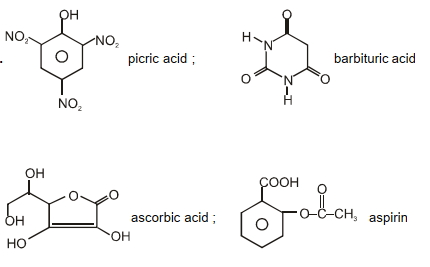
The carboxyl functional group $(- COOH )$ is present in
  • A
    picric acid
  • B
    barbituric acid
  • C
    ascorbic acid
  • aspirin

Answer

Correct option: D.
aspirin
d

Need a full question paper?

Generate a complete, print-ready paper with questions like this in minutes — across 16+ boards, with answer keys.

Start Generating Free

Similar questions

Which of the following will give Fe3+ ions in the solution?
Which of the following has lowest percentage of carbon
The number of unpaired electrons in cobalt atom is (atomic number of $Co = 27$)
Ziegler-Natta catalyst is
The Gibbs energy change (in $J$) for the given reaction at $\left[ Cu ^{2+}\right]=\left[ Sn^{2+}\right]=1\, M$ and $298 \,K$ is:

$Cu ( s )+ Sn ^{2+}( aq ) \rightarrow Cu ^{2+}( aq )+ Sn ( s )$

$\left( E _{ Sn ^{2+} \mid Sn }^{0}=-0.16\, V , E _{ Cu ^{2+} \mid Cu }^{0}=0.34\, V \right.$ Take $F=96500\, C\, mol ^{-1}$ )

The homoleptic and octahedral complex of $Co ^{2+}$ and $H _2 O$ has $.......$ unpaired electron(s) in the $t _{2 g }$ set of orbitals.
For a chemical reaction,$ A + 2B \to C + D,$ the rate of reaction increases three times, when concentration of $A$ only is increased nine times. While when concentration of $B$ only is increased $2\,times,$ then rate of reaction also increases $2\,times$. The order of this reaction is
Which of the following transition metal cation has maximum unpaired electrons
Relationship between products $(Q)$ and $(S)$ is

$\mathrm{CH}_{3}-\mathrm{CH}=\mathrm{CH}_{2}$ $\xrightarrow[{{\text{H}}_{2}}{{\text{O}}_{2}},\bar{O}\text{H}]{\text{B}{{\text{H}}_{3}},\text{THF}}(P)$ $\xrightarrow[\text{C}{{\text{H}}_{2}}\text{C}{{\text{l}}_{2}}]{\text{ Pyridinium Chloro Chromate }(\text{PCC})}$ $(Q)$

$\mathrm{CH}_{3}-\mathrm{CH}=\mathrm{CH}_{2}$ $\xrightarrow[NaB{{H}_{4}}\,,\,H{{O}^{\Theta }}]{Hg\,{{(OAc)}_{2}}\,,\,{{H}_{2}}O}(R)$ $\xrightarrow[\text{C}{{\text{H}}_{2}}\text{C}{{\text{l}}_{2}}]{\text{ Pyridinium Chloro Chromate }(\text{PCC})}$ $(S)$

For the reaction $2NO_2 + F_2 \to  2NO_2F$, following mechanism has been provided :
$N{O_2} + {F_2}\xrightarrow{{slow}}N{O_2}F + F$
$N{O_2} + {F_2}\xrightarrow{{fast}}N{O_2}F$
Thus rate expression of the above reaction can be written as