MCQ
The catalyst used in the contact process is
- A$Fe_2O_3$
- ✓$V_2O_5$
- C$SO_3$
- D$Ag_2O$
Generate a complete, print-ready paper with questions like this in minutes — across 16+ boards, with answer keys.
$1 \mathrm{~mol}$ of an ideal gas is kept in a cylinder, fitted with a piston, at the position $\mathrm{A}$, at $18^{\circ} \mathrm{C}$. If the piston is moved to position $B$, keeping the temperature unchanged, then ' $x$ ' $L$ atm work is done in this reversible process.
$\mathrm{x}=$ . . . . . . $\mathrm{L} \mathrm{atm.} \mathrm{(nearest} \mathrm{integer)}$
[Given : Absolute temperature $={ }^{\circ} \mathrm{C}+273.15$, $\left.\mathrm{R}=0.08206 \mathrm{~L} \mathrm{~atm} \mathrm{~mol}^{-1} \mathrm{~K}^{-1}\right]$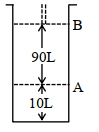
$\left[\Lambda_{\mathrm{m}}=\right.$ molar conductivity
$\Lambda_{\mathrm{m}}^{\circ}=$ limiting molar conductivity
$\mathrm{c}=$ molar concentration
$\mathrm{K}_{\mathrm{a}}=$ dissociation constant of $\mathrm{HX}$ ]
$2 A ( g ) \rightleftharpoons A _{2}( g )$
at $400\, K$ has $\Delta G ^{\circ}=+25.2\, kJ mol ^{-1}$.
The equilibrium constant $K _{ C }$ for this reaction is $...... \times 10^{-2}$. (Round off to the Nearest integ $\left[\right.$ Use $: R=8.3\, J mol ^{-1} K ^{-1}, \ln 10=2.3$
$\left.\log _{10} 2=0.30,1\, atm =1\, bar \right]$
$[$ antilog $(-0.3)=0.501]$