MCQ
The cathode of a photoelectric cell is changed such that the work function changes from $W_1$ to $W_2\left(W_2>W_1\right)$. If the current before and after change are $\mathrm{I}_1$ and $\mathrm{I}_2$, all other conditions remaining unchanged, then (assuming $\mathrm{hn}>\mathrm{W}_2$ )
  • $I_1=I_2$
  • B
    $I_1
  • C
    $I_1>I_2$
  • D
    $I_1

Answer

Correct option: A.
$I_1=I_2$
(a) $I_1=I_2$

Need a full question paper?

Generate a complete, print-ready paper with questions like this in minutes — across 16+ boards, with answer keys.

Start Generating Free

Similar questions

The specific charge of an electron is
 
In space of horizontal $EF$ ($E = (mg)/q$) exist as shown in figure and a mass $m$ attached at the end of a light rod. If mass $m$ is released from the position shown in figure find the angular velocity of the rod when it passes through the bottom most position
The distance of two points on the axis of a magnet from its centre is 10 cm and 20 cm respectively. The ratio of magnetic intensity at these points is 12.5 : 1. The length of the magnet will be
In one model of the electron, the electron of mass $m_e$ is thought to be a uniformly charged shell of radius $R$ and total charge $e$, whose electrostatic energy $E$ is equivalent to its mass $m_e$ via Einstein's mass energy relation $E=m_e c^2$. In this model, $R$ is approximately $\left(m_e=9.1 \times 10^{-31} \,kg , c=3 \times 10^8 \,ms ^{-1}\right.$, $1 / 4 \pi \varepsilon_0=9 \times 10^9 \,Fm ^{-1}$, magnitude of the electron charge $=1.6 \times 10^{-19} \,C$ )
A uniform electric field having a magnitude ${E_0}$ and direction along the positive $X - $ axis exists. If the potential $V$ is zero at $x = 0$, then its value at $X = + x$ will be
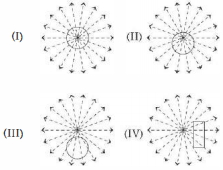
The black shapes in the figure below are closed surfaces. The electric field lines are in red. For which case, the net flux through the surfaces is non-zero?
The addition of antimony atoms to a sample of intrinsic germanium transforms it to a material which is
Given below are two statements:

Statement $I$: Electromagnetic waves carry energy as they travel through space and this energy is equally shared by the electric and magnetic fields.

Statement $II$: When electromagnetic waves strike a surface, a pressure is exerted on the surface.In the light of the above statements, choose the most appropriate answer from the options given below:

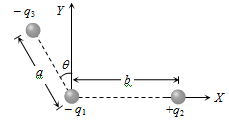
Three charges $-\mathrm{q}_1,+\mathrm{q}_2$ and $-q_3$ are placed as shown in the figure. The x-component of the force on $-q_3$ is proportional to
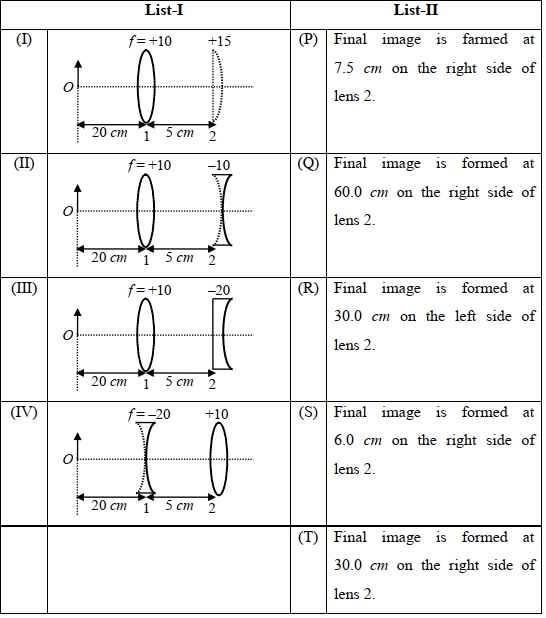
$List I$ contains four combinations of two lenses ($1$ and $2$) whose focal lengths (in $cm$ ) are indicated in the figures. In all cases, the object is placed $20 cm$ from the first lens on the left, and the distance between the two lenses is $5 cm$. $List II$ contains the positions of the final images.

Which one of the following options is correct?