Question
The centre of mass is defined as $\overrightarrow{\text{R}}=\frac{1}{\text{M}}\sum\limits_\text{i}\text{m}_\text{i}\overrightarrow{\text{r}_{\text{i}}}.$ Suppose we define "centre of charge" as $\overrightarrow{\text{R}}_\text{c}=\frac{1}{\text{Q}}\sum\limits_\text{i}\text{q}_\text{i}\overrightarrow{\text{r}_{\text{i}}}$ where $q_i$ represents the $i^{th}$ charge placed at $\overrightarrow{\text{r}_\text{i}}$ and Q is the total charge of the system.
  1. Can the centre of charge of a two-charge system be outside the line segment joining the charges?
  2. If all the charges of a system are in X-Y plane, is it necessary that the centre of charge be in X-Y plane?
  3. If all the charges of a system lie in a cube, is it necessary that the centre of charge be in the cube?
Answer

  1. Center of charge can lie away from line segment joining two charges in case both charges are unequal and are of same charge. but eventually would lie on the axis joining two charges.
  2. Yes in case all charge particles are in same plane the center of charge would lie on same plane.
  3. Yes in case all charges are in cube in that case center of charge would lie on the same cube.

Need a full question paper?

Generate a complete, print-ready paper with questions like this in minutes — across 16+ boards, with answer keys.

Start Generating Free

Similar questions

Derive an expression for the centripetal acceleration of a particle moving with uniform speed V along a circular path of radius r.
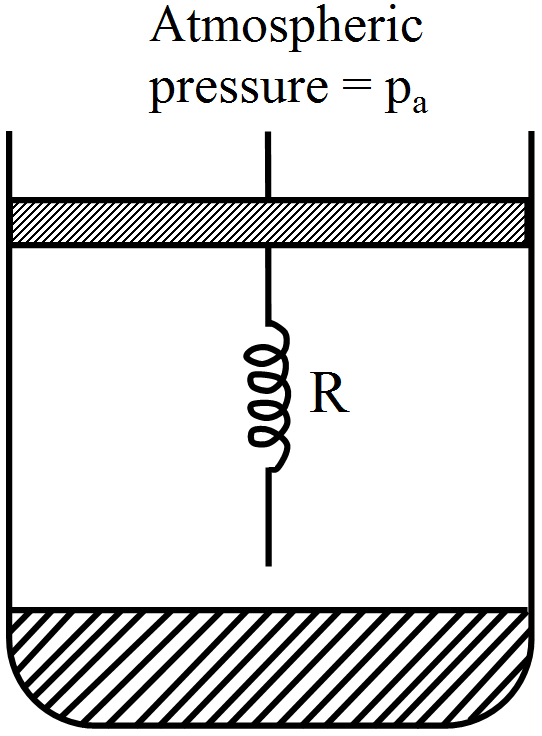
Consider one mole of perfect gas in a cylinder of unit cross-section with a piston attached $($figure$)$. A spring $($spring constant $k)$ is attached $($unstretched length $L)$ to the piston and to the bottom of the cylinder. Initially, the spring is unstretched and the gas is in equilibrium. A certain amount of heat $Q$ is supplied to the gas causing an increase of volume from $V_0$ to $V_1$.
  1. What is the initial pressure of the system?
  2. What is the final pressure of the system?
  3. Using the first law of thermodynamics, write down a relation between $Q, P_a, V, V_0$, and $k$.
A hot gas emits radiation of wavelengths 46.0nm, 82.8nm and 103.5nm only. Assume that the atoms have only two excited states and the difference between consecutive energy levels decreases as energy is increased. Taking the energy of the highest energy state to be zero, find the energies of the ground state and the first excited state.
One mole of an ideal gas is taken in a Carnot engine working between $27°C$ and $227°C$. The useful work done in one cycle is $600J$. Calculate the ratio of the volume of the gas at the end and beginning of the isothermal expansion. Given $R = 8.31J mole^{-1} K^{-1}$.
A rod of mass m and length L, lying horizontally, is free to rotate about a vertical axis through its centre. A horizontal force of constant magnitude F acts on the rod at a distance of $\frac{\text{L}}{4}$ from the centre. The force is always perpendicular to the rod. Find the angle rotated by the rod during the time (t) after the motion starts.
A man of mass $70kg$ stands on a weighing scale in a lift which is moving. Upwards with a uniform acceleration of $5ms^{-2}$. What would be the readings on the scale in each case?
When 0.2 kg of a body at $100^{\circ} \mathrm{C}$ is dropped into 0.5 kg of water at $10^{\circ} \mathrm{C}$, the resulting temperature is $16^{\circ} \mathrm{C}$. Find the specific heat of the body. Specific heat of water is $4.2 \times 10^3 \mathrm{~J} / \mathrm{kg} /{ }^{\circ} \mathrm{C}$.
A square lead slab of side $50\ cm$ and thickness $10 \ cm$ is subject to a shearing force $($on its narrow face$)$ of $9.0 \times10^4 N$. The lower edge is riveted to the floor. How much will the upper edge be displaced?
A SONAR system fixed in a submarine operates at a frequency $40.0 kHz$ . An enemy submarine moves towards the $SONAR$ with a speed of $360 km h ^{-1}$. What is the frequency of sound reflected by the submarine? Take the speed of sound in water to be $1450 m s ^{-1}$.
The sufrace tension and vapour pressure of water at 20°C is $7.28 \times 10^{-2}N$ $m^{-1}$ and $2.33 \times 10^3$ Pa, respectively. What is the radius of the smallest spherical water droplet which can form without evaporating at 20°C?