The change in optical rotation with time of freshly prepared solutions of sugar is known as
Easy


Download our appand get started for free
Experience the future of education. Simply download our apps or reach out to us for more information. Let's shape the future of learning together!No signup needed.*
Similar Questions
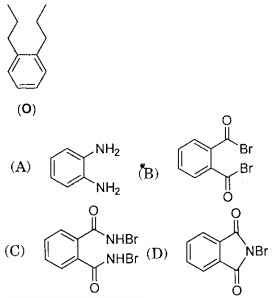
- 1Treatment of compound $O$ with $KMnO_4 / \mathrm{H}^{+}$gave $P$, which on heating with ammonia gave $Q$. The compound $Q$ on treatment with $Br_2 / NaOH$ produced $R$. On strong heating, $Q$ gave $S$, which on further treatment with ethyl $2$-bromopropanoate in the presence of $KOH$ followed by acidification, gave a compound $T$.View Solution
(image)
($1$) The compound $R$ is
(image)
($2$) The compound $T$ is
($A$) glycine
($B$) alanine
($C$) valine
($D$) serine
Given the answer question ($1$) and ($2$)
- 2Alanine $\xrightarrow{\Delta }$ Product, total number of product formed in this reactionView Solution
- 3View SolutionWhich of the following is not essential amino acid
- 4View SolutionWhich of the following is water soluble vitamin ?
- 5The optical rotation of the $\alpha$ - form of a pyranose is $+ 150.7^o$, that of the $\beta$ - form is $+ 52.8^o$. In solution an equilibrium mixture of these anomers has an optical rot ation of $+ 80.2^o$. The percentage of the $\alpha$ -form in equilibrium mixture is ....... $\%$View Solution
- 6View SolutionWhich of the following is an amine hormone?
- 7View SolutionWhich one is a disaccharide
- 8View SolutionWhich of the following statements about ribose is incorrect
- 9The number of $sp^2$ hybridised carbons present in "Aspartame" isView Solution
- 10Match List$-I$ with List$-II$View Solution
List$-I$ List$-II$ $(a)$ Sucrose $(i)$ $\beta$ -D-Galactose and $\beta$ -D-Glucose
$(b)$ Lactose $(ii)$ $\alpha$ -D-Glucose and $\beta$ -D-Fructose $(c)$ Maltose $(iii)$ $\alpha$ -D-Glucose and $\alpha$ -D-Glucose Choose the correct answer from the options given below: