The charge flowing through a resistor $R$ varies with time $t$ as $Q = 3t -6t^2.$ The heat produced in $R$ till the current in it becomes zero is
Medium
Download our app for free and get started
$\mathrm{i}=\frac{\mathrm{d} Q}{\mathrm{dt}}=3-12 \mathrm{t}$
$t=\frac{1}{4} \sec$
$\mathrm{H}-\int_{0}^{1 / 4}(3-12 \mathrm{t})^{2} \times \mathrm{Rdt}$
$=\left.\frac{(3-12 t)^{2}}{3 x-12}\right|_{0} ^{1 / 4} R$
$=\frac{+1}{36}[27]=\frac{3 \mathrm{R}}{4}$

Download our appand get started for free
Experience the future of education. Simply download our apps or reach out to us for more information. Let's shape the future of learning together!No signup needed.*
Similar Questions
- 1The charge of an electron is $1.6 × 10^{-19}\,C$. How many electrons strike the screen of a cathode ray tube each second when the beam current is $16\,mA$View Solution
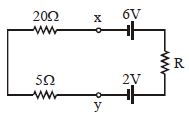
- 2The current flowing in the given circuit is $0.1\,A$ . The potential difference between the points $X$ and $Y$ is ................ $\mathrm{V}$View Solution
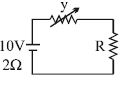
- 3In the figure shown the power generated in $y$ is maximum when $y = 5\,\Omega $. Then $R$ isView Solution
- 4The resistance of a wire is $20\, ohms$. It is so stretched that the length becomes three times, then the new resistance of the wire will be ............. $ohms$View Solution
- 5Two resistances ${R_1}$ and ${R_2}$ are made of different materials. The temperature coefficient of the material of ${R_1}$ is $\alpha $ and of the material of ${R_2}$ is $ - \beta $. The resistance of the series combination of ${R_1}$ and ${R_2}$ will not change with temperature, if ${R_1}/{R_2}$ equalsView Solution
- 6$A$ current passes through a wire of nonuniform cross section. Which of the following quantities are independent of the cross-section?View Solution
- 7View SolutionTwo wires of the same material are given. The first wire is twice as long as the second and has twice the diameter of the second. The resistance of the first will be
- 8A current of $2\,A$ flows through a wire of crosssectional area $25.0\,mm ^2$. The number of free electrons in a cubic meter are $2.0 \times 10^{28}$. The drift velocity of the electrons is $...............\times 10^{-6}\,ms ^{-1}$ (given, charge on electron $=1.6 \times 10^{-19}\,C$ )View Solution
- 9Copper and silicon is cooled from $300\; K$ to $60\; K$, the specific resistanceView Solution
- 10The charge flowing through a resistance $R$ varies with time $t$ as $ Q=at-bt^2 $ where $a$ and $b$ are positive constants . The total heat produced in $R$ isView Solution