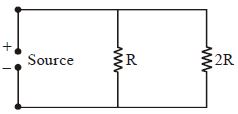
The charge supplied by source varies with time $'t'$ as $Q = at -bt^2$. The total heat produced in the resistor $2R$ before current reduces to zero
Diffcult


Download our appand get started for free
Experience the future of education. Simply download our apps or reach out to us for more information. Let's shape the future of learning together!No signup needed.*
Similar Questions
- 1Two identical batteries, each of $e.m.f.$ $2\, volt$ and internal resistance $1.0\, ohm$ are available to produce heat in an external resistance $R = 0.5\,ohm$ by passing a current through it. The maximum Joulean power that can be developed across $R$ using these batteries is ............. $watt$View Solution
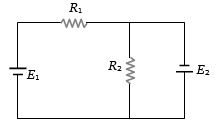
- 2Two resistances ${R_1}$ and ${R_2}$ are joined as shown in the figure to two batteries of $e.m.f.$ ${E_1}$ and ${E_2}$. If ${E_2}$ is short-circuited, the current through ${R_1}$ isView Solution
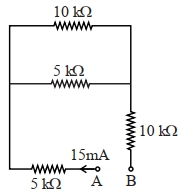
- 3A current of $15\,mA$ flows in the circuit as shown in figure. The value of potential difference between the points $A$ and $B$ will be $...\,V$View Solution
- 4An electric kettle has two coils. When one of these is switched on, the water in the kettle boils in $6\,\min$ . When the other coil is switched on, the water boils in $3\,\min$. If the two coils are connected in series, the time taken to boil the water in the kettle is ............. $min$View Solution
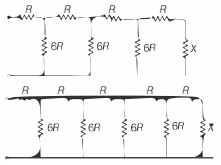
- 5For what value of the resistor $X$ will the equivalent resistance of the two circuits shown be the same?View Solution
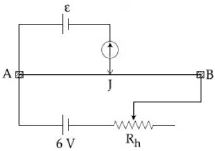
- 6The resistance of the meter bridge $AB$ in given figure is $4\,\Omega $. With a cell of emf $\varepsilon \, = 0.5\,\,V$ and rheostat resistance $R_h = 2\,\Omega $ the null point is obtained at some point $J.$ When the cell is replaced by another one of emf $\varepsilon \, = {\varepsilon _2}$ the same null point $J$ is found for $R_h = 6\,\Omega .$ The $emf$ ${\varepsilon _2}$ is ................. $V$View Solution
- 7Three resistors are connected to form the sides of a triangle $ABC$, the resistance of the sides $AB$, $BC$ and $CA$ are $40\,ohms$, $60\,ohms$ and $100\,ohms$ respectively. The effective resistance between the points $A$ and $B$ in $ohms$ will beView Solution
- 8$A$ wire of length $L$ and $3$ identical cells of negligible internal resistances are connected in series. Due to the current, the temperature of the wire is raised by $\Delta T$ in time $t. N$ number of similar cells is now connected in series with a wire of the same material and cross section but of length $2L$. The temperature of the wire is raised by the same amount $\Delta T$ in the same time $t$. The value of $N$ is :View Solution
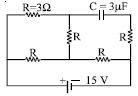
- 9In the circuit shown, the cell is ideal, with $emf$ $=$ $15$ $V$. Each resistance is of $3 $ $\Omega$ . The potential difference across the capacitor is.....$V$View Solution
- 10If two bulbs of wattage $25$ and $30$, each rated at $220\, volts$, are connected in series with a $440$ $volt$ supply, which bulb will fuseView Solution