Question
The choice of a reducing agent in a particular case depends on thermodynamic factor. How far do you agree with this statement? Support your opinion with two examples.

Answer

We can study the choice of a reducing agent in a particular case using Ellingham diagram. It is evident from the diagram that metals for which the standard free energy of formation oftheir oxides is more negative can reduce those metal oxides for which the standard free energy of formation of their respective oxides is less negative. It means that any metal will reduce the oxides of other metals which lie above it in the Ellingham diagram. This is because the standard free energy change $(\Delta_{\text{r}}\text{G}^{\circ})$ of the combined redox reaction will be negative by an amount equal to the difference in $\Delta_{\text{f}}\text{G}^{\circ}$ of the two metal oxides. Thus both Al and $Zn$ can reduce $FeO$ to Fe but Fe cannot reduce $Al_2O_3$ to $A1$ and $ZnO$ to $Zn$. In the same way, G can reduce $ZnO$ to Zn but not $CO.$
Note: Only that reagent will be preferred as reducing agent which will lead to decrease in free energy value $(\Delta\text{G}^{\circ})$ at a certain specific temperature.

Need a full question paper?

Generate a complete, print-ready paper with questions like this in minutes — across 16+ boards, with answer keys.
Start Generating Free

Similar questions

Low density polythene and high density polythene, both are polymers of ethene but there is marked difference in their properties. Explain.
Explain preparation of haloarene compounds from hydrocarbons.
Given that the standard electrode potentials $(E^o)$ of metals are:
$K^+/K = –2.93\ V,\ Ag^+/Ag = 0.80\ V,\ Cu^{2+}/Cu = 0.34\ V,$
$Mg^{2+}/Mg = -2.37\ V,\ Cr^{3+}/Cr = – 0.74\ V,\ Fe^{2+}/Fe = – 0.44\ V.$
Arrange these metals in an increasing order of their reducing power.
Note: In the following questions a statement of assertion followed by a statement of reason is given. Choose the correct answer out of the following choices.
Assertion: An ordinary filter paper impregnated with collodion solution stops the flow of colloidal particles.
Reason: Pore size of the filter paper becomes more than the size of colloidal particle.
What is a slag?
Calculate the freezing point of a solution containing $0.520 g$ glucose $(C_6H_{12}O_6)$ dissolved in $80.20 g$ of water. (For water $Kf = 1.86 K \ kg \ mol^{-1})$
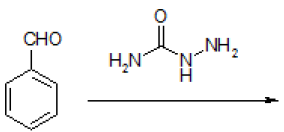
Complete each synthesis by giving missing starting material, reagent or products:-
Image
Answer the following:
(a) For a certain reaction large fraction of molecules has energy more than the threshold energy, yet the rate of reaction is very slow. Why?
(b) State a condition under which a bimolecular reaction is kinetically first-order reaction.
Write the reactions taking place in the electrolysis of dilute and concentrated $H _2 SO _4$.
$a.$ Nitrogen gas is soluble in water. At temperature $293 K,$ the value of $K_HiS 76.48$ kbar. How would the solubility of nitrogen vary $($ increase, decrease or remain the same $)$ at a temperature above $293 K_H$ if the value of $K_1$ rises to $88.8$ kbar.
$b.$ Chloroform $($ b.p. $61.2^\circ C)$ and acetone $($ b.p. $56^\circ C)$ are mixed to form an azeotrope. The mole fraction of acetone in this mixture is $0.339.$ Predict whether the boiling point of the azeotrope formed will be $(i) 60^\circ C \ (ii) 64.5^\circ C$ or $(iii)54 ^\circ C.$ Defend your answer with reason.