MCQ
The complex ion which has no $'d'$ electrons in the central metal atom is :
  • A
    $[Co(NH_3)_6]^{3+}$
  • B
    $[Fe(CN)_6]^{3-}$
  • $[Cr(H_2O)_6]^{3+}$
  • D
    $[MnO_4]^-$

Answer

Correct option: C.
$[Cr(H_2O)_6]^{3+}$
c
Theory based

Need a full question paper?

Generate a complete, print-ready paper with questions like this in minutes — across 16+ boards, with answer keys.

Start Generating Free

Similar questions

If $Z_{eff}$ of boron is $x$ then $Z_{eff}$ of oxygen will be
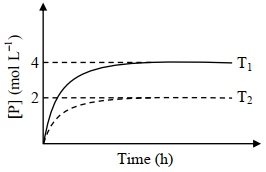
In a one-litre flask, 6 moles of $A$ undergoes the reaction $A(\mathrm{~g}) \rightleftharpoons \mathrm{P}(\mathrm{g})$. The progress of product formation at two temperatures (in Kelvin), $\mathrm{T}_1$ and $\mathrm{T}_2$, is shown in the figure:

If $T_1=2 T_2$ and $\left(\Delta G_2^{\Theta}-\Delta G_1^{\varphi}\right)=R T_2 \ln x$, then the value of $x$ is. . . . .

$\left[\Delta G_1^\theta\right.$ and $\Delta G_2^\theta$ are standard Gibb's free energy change for the reaction at temperatures $T_1$ and $T_2$, respectively.]
Which of the following molecules are expected to exhibit intermolecular $H-$ bonding?

$(I)$ Acetic acid $(II)\, o-$ nitrophenol  $(III)\, m-$ nitrophenol $(IV)\, o-$ boric acid
Select correct alternate

If monosaccharide contains an aldehyde group, it is known as
$98\,\,mg$  of  $H_2SO_4$  present in $100\,\,g$  of solution then molarity of solution will be. If density of solution is $1.25\,\,g/mL$
The degree of dissociation of $0.1\,M\,HCN$ solution is $0.01\%$ . Its ionisation constant would be
Catalyst $A$ reduces the activation energy for a reaction by $10\, k\,J\, mol ^{-1}$ at $300\, K$. The ratio of rate $\frac{ k _{ T }, \text { Catalysed }}{ k _{ T }, \text { Uncatalysed }}$ is $e ^{ x }$ [nearest integer $]$

[Assume theat the pre-exponential factor is same in both the cases.

Given $R =8.31 \,J\, K ^{-1} \,mol ^{-1}$ ]

$XeF _4$ reacts with $SbF _5$ to form ${\left[ XeF _{ m }\right]^{ n +}\left[ SbF _{ y }\right]^{ z- }}$ $m + n + y + z =.......$.
Consider the following reaction

${C_6}{H_5}N{O_2}\xrightarrow{{Sn / HCl}}X\xrightarrow{{{C_6}{H_5}COCl}}Y + HCl$

What is $Y$ ?

Which of the following statements does not form part of Bohr's model of the hydrogen atom