MCQ
The complex that can show optical activity is:
  • A
    trans- $\left[ Fe \left( NH _{3}\right)_{2}( CN )_{4}\right]^{-}$
  • B
    $\operatorname{cis}\left[ Fe \left( NH _{3}\right)_{2}( CN )_{4}\right]^{-}$
  • $\operatorname{cis}-\left[\operatorname{CrCl}_{2}(\operatorname{ox})_{2}\right]^{3-}($ ox $=$ oxalate $)$
  • D
    $\operatorname{trans}-\left[\operatorname{Cr}\left( Cl _{2}\right)( ox )_{2}\right]^{3-}$

Answer

Correct option: C.
$\operatorname{cis}-\left[\operatorname{CrCl}_{2}(\operatorname{ox})_{2}\right]^{3-}($ ox $=$ oxalate $)$
c

Need a full question paper?

Generate a complete, print-ready paper with questions like this in minutes — across 16+ boards, with answer keys.

Start Generating Free

Similar questions

The solubility product of $Mg{(OH)_2}$ is $1.2 \times {10^{ - 11}}$. The solubility of this compound in gram per $100\,c{m^3}$ of solution is
Collision theory is used to explain how chemical species undergo a reaction. Using this theory and the kinetic molecular model, which of the following does $NOT$ influence the rate of a chemical reaction?
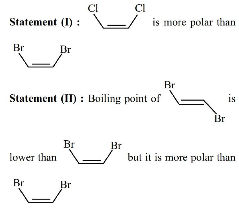
Given below are two statements :
Image
In the light of the above statements, choose the most appropriate answer from the options given below :
An example of a compound with the functional group $' - O - '$ is
The end product of the reactions is

${{C}_{2}}{{H}_{5}}N{{H}_{2}} \xrightarrow{HN{{O}_{2}}}A \xrightarrow{PC{{l}_{5}}}B \xrightarrow{H.N{{H}_{2}}}C$

Which of the following fact$(s)$ explain$(s)$ as to why $p-$ nitrophenol is more acidic than phenol?

$I$. $-I$ Effect of nitro group.

$II$. Greater resonance effect of $p-$ nitrophenoxy group

$III$. Steric effect of bulky nitro group

Consider the following groups :

$(I)$ $-OAc$                        $(II)$ $-OMe$

$(III)$ $-O-SO_2-Me$          $(IV)$ $-O-SO_2-CF_3$

The order of leaving power is :

In the organic compound $CH _{2}= CH - CH _{2}- CH _{2}- C \equiv CH ,$ the pair of hydridised orbitals involved in the formation of: $C_{2}-C_{3}$ bond is:
Match List $I$ with List $II$

List $-I$

(Element)

  List $-II$ (Electronic Configuration)  
$A.$ $N$ $I.$ $[\mathrm{Ar}] 3 \mathrm{~d}^{10} 4 \mathrm{~s}^2 4 \mathrm{p}^5$
$B.$ $S$ $II.$ $[\mathrm{Ne}] 3 \mathrm{~s}^2 3 \mathrm{p}^4$
$C.$ $Br$ $III.$ $[\mathrm{He}] 2 \mathrm{~s}^2 2 \mathrm{p}^3$
$D.$ $Kr$ $IV.$ $[\mathrm{Ar}] 3 \mathrm{~d}^{10} 4 \mathrm{~s}^2 4 \mathrm{p}^6$

Choose the correct answer from the options given below:

What is the potential of the cell containing two hydrogen electrodes as represented below ........... $\mathrm{V}$

$Pt:\frac{1}{2}\,{H_2}\left( g \right)\,|{H^ + }\left( {{{10}^{ - 8}}\,M} \right)||{H^ + }\,\left( {{{10}^{ - 3}}\,M} \right)|\frac{1}{2}\,{H_2}\left( g \right)\,;Pt$