MCQ
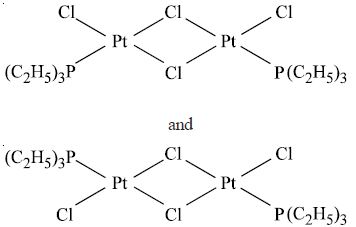
The complexes given below show :
  • A
    Optical isomerism
  • B
    Co-ordination isomerism
  • Geometrical isomerism
  • D
    Bridged isomerism

Answer

Correct option: C.
Geometrical isomerism
c
Metal complexes that differ only in which ligands are
adjacent to one another (cis) or directly across from one
another (trans) in the coordination sphere of the metal
are called geometrical isomers.

Need a full question paper?

Generate a complete, print-ready paper with questions like this in minutes — across 16+ boards, with answer keys.

Start Generating Free

Similar questions

Enol percentage of following compound is maximum
$\Delta H_{fusion}$ of a substance is $'x'$ and $\Delta H_{vap}$ is $'y'$, then $\Delta H_{sublimation}$ will be
A mixture containing the following four compounds is extracted with $1 \,M\, HCl$. The compound that goes to aqueous layer is
The partial pressures of $C{H_3}OH,\,CO$ and ${H_2}$ in the equilibrium mixture for the reaction $CO + 2{H_2}$ $\rightleftharpoons$ $CH_3OH$ at $427\,^oC$ are $2.0$, $1.0$ and $0.1$ $atm$ respectively. The value of ${K_P}$ for the decomposition of $C{H_3}OH$ to $CO$ and ${H_2}$ is
Consider separate solutions of $0.500\, M\, C_2H_5OH\,(aq),$ $0.100\,M\,Mg_3(PO_4)_2\, (aq), $ $0.250\, M\,KBr\,(aq)$ and $0.125\, M\,Na_3PO_4\,(aq)$ at $25^o C.$ Which statement is true about these solutions, assuming all salts to be strong electrolytes ?
Consider the following reaction $\mathrm{A}+\mathrm{B} \rightarrow \mathrm{C}$

The time taken for $A$ to become $1 / 4^{\text {th }}$ of its inital concentration is twice the time taken to become $1 / 2$ of the same. Also, when the change of concentration of $B$ is plotted against time, the resulting graph gives a straight line with a negative slope and a positive intercept on the concentration axis. The overall order of the reaction is . . . . .

In case of osmosis solvent molecules move from
If $A$ is $[Rn]\,6d^2\,7s^2$ then identify block, period, group?
Hybridisation state of chlorine in $Cl{F_3}$ is
In the following reaction, $4P + 3KOH + 3{H_2}O \to 3K{H_2}P{O_2} + P{H_3}$