MCQ
The compound $ ‘A$’ when treated with ceric ammonium nitrate solution gives yellow ppt. The compound $ ‘A’$  is
  • Alcohol
  • B
    Aldehyde
  • C
    Acid
  • D
    Alkane

Answer

Correct option: A.
Alcohol
a
(a)$\mathop {R - OH}\limits_{{\rm{alcohol}}} + \mathop {{{(N{H_4})}_2}Ce{{(N{O_3})}_6}}\limits_{{\rm{Cerric}}\,\,{\rm{amm}}{\rm{.}}\,\,{\rm{nitrate}}} \to \mathop {Ce{{(N{O_3})}_6}{{(ROH)}_9}}\limits_{{\rm{yellow}}\,\,ppt{\rm{.}}} + 2N + 14N{O_3}$

Need a full question paper?

Generate a complete, print-ready paper with questions like this in minutes — across 16+ boards, with answer keys.
Start Generating Free

Similar questions

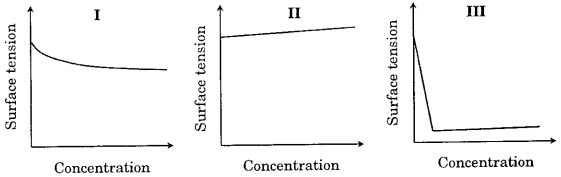
The qualitative sketches $I, II$ and $III$ given below show the variation of surface tension with molar concentration of three different aqueous solutions of $\mathrm{KCl}, \mathrm{CH}_3 \mathrm{OH}$ and $\mathrm{CH}_3\left(\mathrm{CH}_2\right)_{11} \mathrm{OSO}_3{ }^{-} \mathrm{Na}^{+}$at room temperature. The correct assignment of the sketches is
Two first order reactions have half-lives in the ratio $3 : 2$ . Calculate the ratio of time intervals $t_1 : t_2$ if $t_1$ is the time period for $25\%$ completion of the first reaction and $t_2$ for $75\%$ completion of the second reaction
Which of the following is not correct regarding basic strength?
$H_2S$ is a toxic gas used in qualitative analysis. If solubility of $H_2S$ in water at $\text{STP}$ is $0.195m.$ what is the value of $K_H?$
(image) $\xrightarrow[{(2)\,{H_2}O/Zn}]{{(1)\,{O_3}}}\mathop X\limits_{\left( {{C_2}{H_4}O} \right)}  + \mathop Y\limits_{\left( {{C_3}{H_6}O} \right)} $ 

$X\xrightarrow[{\left( 2 \right)\,{H_2}O}]{{\left( 1 \right)\,LiAl{H_4}}}P$

$Y\xrightarrow[{\left( 2 \right)\,{H_2}O}]{{\left( 1 \right)\,LiAl{H_4}}}Q$

Incorrect statement for $X, Y, P$ and $Q$ is
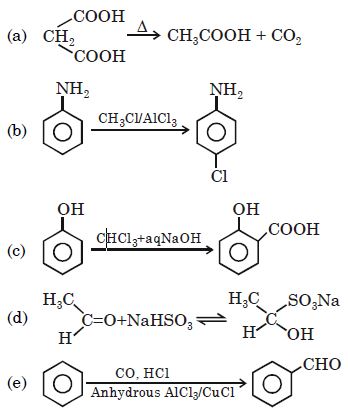
Which of the following reaction is incorrect
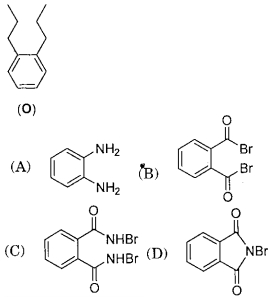
Treatment of compound $O$ with $KMnO_4 / \mathrm{H}^{+}$gave $P$, which on heating with ammonia gave $Q$. The compound $Q$ on treatment with $Br_2 / NaOH$ produced $R$. On strong heating, $Q$ gave $S$, which on further treatment with ethyl $2$-bromopropanoate in the presence of $KOH$ followed by acidification, gave a compound $T$.

(image)

($1$) The compound $R$ is

(image)

($2$) The compound $T$ is

($A$) glycine

($B$) alanine

($C$) valine

($D$) serine

Given the answer question ($1$) and ($2$) 
Arrange the following in the order of their decreasing electrode potential $Mg, K, Ba, Ca$
The major products $P$ and $Q$ are
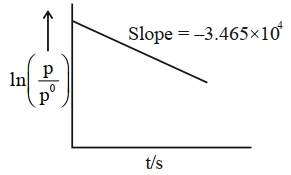
For the decomposition of azomethane. $CH _{3} N _{2} CH _{3}( g ) \rightarrow CH _{3} CH _{3}( g )+ N _{2}$ (g) a first order reaction, the variation in partial pressure with time at $600\,K$ is given as