MCQ
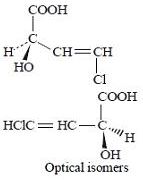
The compound $CHCl = CHCHOHCOOH$ with molecular formula $C_4H_5O_3Cl$ can exhibit
  • geometric, optical position and functional isomerism
  • B
    geometric, optical and functional isomerism only
  • C
    position and functional isomerism only
  • D
    geometric and optical isomerism only

Answer

Correct option: A.
geometric, optical position and functional isomerism
a
$\underset{Geometric\,isomers\,\,\,\,\,\,\,\,\,\,\,\,}{\mathop{\begin{align}
   \underset{\,\,\,cis\,\,\,\,\,\,\,\,\,\,\,\,\,\,\,\,\,\,\,\,\,\,\,\,\,\,\,\,\,\,\,\,\,\,}{\mathop{\begin{matrix}
   ^{H}  \\
   _{Cl}  \\
\end{matrix}\begin{matrix}
   \backslash   \\
   /  \\
\end{matrix}C=C\begin{matrix}
   /  \\
   \backslash   \\
\end{matrix}_{CHOHCOOH}^{H}}}\, \\ 
  \underset{trans\,\,\,\,\,\,\,\,\,\,\,\,\,\,\,\,\,\,\,\,\,\,\,\,\,\,\,}{\mathop{\begin{matrix}
   ^{H}  \\
   _{Cl}  \\
\end{matrix}\begin{matrix}
   \backslash   \\
   /  \\
\end{matrix}C=C\begin{matrix}
   /  \\
   \backslash   \\
\end{matrix}_{H}^{CHOHCOOH}}}\, \\ 
\end{align}}}\,$

$\begin{matrix}
   \,\,\,\,\,O  \\
   \,\,\,\,\,||  \\
   CH=C-C-OC{{H}_{3}}  \\
   \,\,|\,\,\,\,\,\,\,\,\,\,\,\,\,|\,\,\,\,\,\,\,\,\,\,\,\,\,\,\,\,\,\,\,\,\,\,\,\,\,\,\,\,\,\,\,\,\,\,\,  \\
   \,Cl\,\,\,\,\,\,\,\,\,OH\,\,\,\,\,\,\,\,\,\,\,\,\,\,\,\,\,\,\,\,\,\,\,\,\,\,\,\,\,\,\,\,\,  \\
\end{matrix}$ , $\begin{matrix}
   \,\,\,\,\,\,\,\,\,\,\,\,\,\,\,O  \\
   \,\,\,\,\,\,\,\,\,\,\,\,\,\,\,||  \\
   C{{H}_{3}}=C=C-OH  \\
   \,\,|\,\,\,\,\,\,\,\,\,\,\,\,\,|\,\,\,\,\,\,\,\,\,\,\,\,\,\,\,\,\,\,\,\,\,\,\,\,\,\,\,\,\,\,\,\,\,\,\,  \\
   \,Cl\,\,\,\,\,\,\,\,\,OH\,\,\,\,\,\,\,\,\,\,\,\,\,\,\,\,\,\,\,\,\,\,\,\,\,\,\,\,\,\,\,\,\,  \\
\end{matrix}$

           Functional isomers

$\begin{matrix}
   H\,\,\,\,\,\,\,\,\,\,\,\,\,\,\,\,  \\
   |\,\,\,\,\,\,\,\,\,\,\,\,\,\,\,\,\,  \\
   {{H}_{2}}C-C=C-COOH  \\
   |\,\,\,\,\,\,\,\,\,\,\,\,\,\,\,\,\,\,\,\,\,\,|\,\,\,\,\,\,\,\,\,\,\,\,\,\,\,\,\,\,\,\,  \\
   Cl\,\,\,\,\,\,\,\,\,\,\,\,\,\,\,\,\,\,OH\,\,\,\,\,\,\,\,\,\,\,\,\,\,\,\,\,  \\
\end{matrix}$ , $\begin{matrix}
   {{H}_{2}}C-C=CH-COOH  \\
   |\,\,\,\,\,\,\,\,\,\,\,\,|\,\,\,\,\,\,\,\,\,\,\,\,\,\,\,\,\,\,\,\,\,\,\,\,\,\,\,\,\,\,\,\,\,\,\,\,  \\
   Cl\,\,\,\,\,\,\,OH\,\,\,\,\,\,\,\,\,\,\,\,\,\,\,\,\,\,\,\,\,\,\,\,\,\,\,\,\,\,\,\,\,  \\
\end{matrix}$

            Position isomers
Need a full question paper?

Generate a complete, print-ready paper with questions like this in minutes — across 16+ boards, with answer keys.

Start Generating Free

Similar questions

In the estimation of sulphur organic compound on treating with conc. $HN{O_3}$ is converted to
$\mathrm{BF}_{3}$ is planar and electron deficient compound. Hybridization and number of electrons around the central atom, respectively are:
Acetic acid exists as dimer in benzene due to
In thermodynamics, a process is called reversible when
For the hypothetical reaction

${A_2}\left( g \right) + {B_2}\left( g \right) \rightleftharpoons 2AB\left( g \right)$

${\Delta _r}{G^o}$ and ${\Delta _r}{S^o}$ are $20\, kJ/mol$ and $-20\, JK^{-1}\, mol^{-1}$ respectively at $200\, K$.

If ${\Delta _r}{C_P}$ is $20\, JK^{-1}\, mol^{-1}$ then ${\Delta _r}{H^o}$ at $400\, K$ is.....$kJ/mol$

How many electrons can be fit into the orbitals that comprise the ${3^{rd}}$ quantum shell $n = 3$
Match the List$-I$ with List$-II$ :
Cations Group reaction
$P \rightarrow Pb ^{2+}, Cu ^{2+}$ $(i)$ $H _2 S$ gas in presence of dilute $HCl$
$Q \rightarrow Al ^{3+}, Fe ^{3+}$ $(ii)$ $\left( NH _4\right)_2 CO _3$ in presence of $NH _4 OH$
$R \rightarrow Co ^{2+}, Ni ^{2+}$ $(iii)$ $NH _4 OH$ in presence of $NH _4 CI$
$S \rightarrow Ba ^{2+}, Ca ^{2+}$ $(iv)$ $H _2 S$ in presence of $NH _4 OH$
For which of the following reaction, product formation is favoured at low pressure and low temperature ?
The number of orbitals in $2p$ sub-shell is
What volume of oxygen gas $(O_2)$ measured at $0\,^o C$ and $1\ atm,$ is needed to burn completely $1\ L$ of propane gas $(C_3H_8)$ measured under the same conditions? .......... $\mathrm{L}$