MCQ
The compound formed when ethyl bromide is heated with dry silver oxide is
  • A
    Dimethyl ether
  • Diethyl ether
  • C
    Methyl alcohol
  • D
    Ethyl alcohol

Answer

Correct option: B.
Diethyl ether
b
(b) $2{C_2}{H_5}Br + \mathop {A{g_2}O}\limits_{{\rm{Dry}}} \to {C_2}{H_5} - O - {C_2}{H_5} + 2AgBr$

If we take moist $A{g_2}O$ then alcohol is formed

$A{g_2}O + {H_2}O \to 2AgOH$

${C_2}{H_5}Br + AgOH \to {C_2}{H_5}OH + AgBr$

Need a full question paper?

Generate a complete, print-ready paper with questions like this in minutes — across 16+ boards, with answer keys.

Start Generating Free

Similar questions

An aqueous solution ox $X$ is added slowly to an aqueous solution of $Y$ as shown in list $I$. The variation in conductivity of these reactions is given in List $II$. Match List $I$ with List $II$ and select the correct answer using the code given below the lists :

List $I$ List $II$
$P$. $\quad \underset{X}{\left( C _2 H _5\right)_3 N }+\underset{ Y }{ CH _3 COOH }$ $1.$ Conductivity decreases and then increases
$Q.$ $\quad \underset{X}{ KI (0.1 M )}+\underset{ Y }{ AgNO _3(0.01 M )}$ $2.$ Conductivity decreases and then does not change much
$R.$ $\quad \underset{X}{ CH _3 COOH }+\underset{ K }{ KOH }$ $3.$ Conductivity increases and then does not change much
$S$. $\quad \underset{X}{ NaOH }+\underset{Y}{ HI }$ $4.$ Conductivity does not change much and then increases

Codes: $ \quad P \quad Q \quad R \quad S $ 
Of the different allotropes of phosphorus, the one which is most reactive is
Fluorine is a better oxidising agent than $B{r_2}$. It is due to
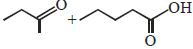
Alkene $(X)$ $\xrightarrow[\Delta ]{{KMn{O_4}}}$ (figure) + (figure) $X$ is
Which is the chemical test for polysaccharide
Which of the following elements have half-filled $f$-orbitals in their ground state ?

(Given : atomic number $Sm =62 ; Eu =63 ; Tb =65 ; Gd =64, Pm =61 \text { ) }$

$A.$ $Sm$   $B.$ $Eu$   $C.$ $Tb$   $D.$ $Gd$   $E.$ $Pm$

Choose the correct answer from the options given below:

Elements of $d$ group are called
The order of increasing ionic radius of the following is
Hydrogen can be put in halogen group because
At $298\, K$, the standard reduction potentials are $1.51\, V$ for $MnO_4^ - \,|\,M{n^{2 + }}$, $1.36\, V$ for $C{l_2}\,|\,C{l^ - }$, $1.07\, V$ for $B{r_2}\,|\,B{r^ - }$ and $0.54\, V$ for ${I_2}\,|\,{I^ - }$. At $pH\, = 3$ , permanganate is expected to oxidize $\left( {\frac{{RT}}{F} = 0.059\,V} \right)$