MCQ
The compound most reactive towards $S _{ N } 1$ reaction is :
  • A
    $MeCOCH _{2} Cl$
  • B

  • C
    $C _{6} H _{5} CH _{2} CH _{2} Cl$
  • $MeOCH _{2} Cl$

Answer

Correct option: D.
$MeOCH _{2} Cl$
d
The $SN _{1}$ reaction for $MeCOCH _{2} Cl$ is given as,

$MeOCH _{2} Cl$ $\xrightarrow{Slow}$$\underset{(i)}{\mathop{Me\underset{\,\,\centerdot \,\,\centerdot }{\overset{\centerdot \,\,\centerdot }{\mathop{O}}}\,\overset{+}{\mathop{C{{H}_{2}}}}\,+C{{l}^{-}}}}\,$  $\leftrightarrow $  $\underset{(ii)}{\mathop{Me-\underset{\,\,\centerdot \,\,\centerdot }{\overset{+}{\mathop{O}}}\,=C{{H}_{2}}}}\,$

Though $(ii)$ contains positive charge on oxygen, octet around each atom in $(ii)$ is complete, structure $(ii)$ is more stable than $(i)$.

Need a full question paper?

Generate a complete, print-ready paper with questions like this in minutes — across 16+ boards, with answer keys.

Start Generating Free

Similar questions

Which of the following compounds gives trichloromethane on distilling with bleaching powder
Photoelectric effect shows
At equilibrium on increasing pressurre boiling point of $H_2O$
Which of the following can react with $K _{2} Cr _{2} O _{7}$
$K,\,\,Ca$ and $Li$ metals may be arranged in the decreasing order of their standard electrode potentials as
Given below are two statements: One is labelled as Assertion ($A$) and the other is labelled as Reason ($R$)

Assertion ($A$): Enthalpy of neutralisation of strong monobasic acid with strong monoacidic base is always $-57 \mathrm{~kJ} \mathrm{~mol}^{-1}$

Reason ($R$): Enthalpy of neutralisation is the amount of heat liberated when one mole of $\mathrm{H}^{+}$ions furnished by acid combine with one mole of ${ }^{-} \mathrm{OH}$ ions furnished by base to form one mole of water. In the light of the above statements, choose the correct answer from the options given below.
The order of the magnitude of first ionisation potentials of $Be, B, N$ and $O$ is
Oxidation number of $As$ atoms in ${H_3}As{O_4}$ is
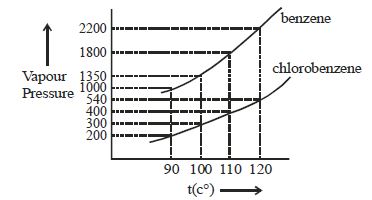
Assuming the formation of an ideal solution, determine the boiling point of a mixture containing $1560\, g$ benzene (molar mass $= 78$) and $1125\, g$ chlorobenzene (molar mass $= 112.5$) using the following against an external pressure of $1000\, torr$ .......... $^oC$.
$A + B$ $\rightleftharpoons$ $C + D$. If finally the concentration of $A $ and $B$ are both equal but at equilibrium concentration of $ D$ will be twice of that of $A$ then what will be the equilibrium constant of reaction.