MCQ
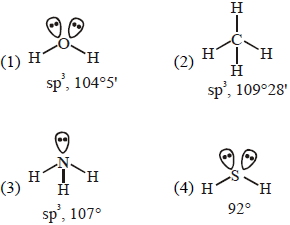
The compound that has the largest $H - M - H$ bond angle $( M = N , O , S , C ),$ is :
  • A
    $H _{2} O$
  • $CH _{4}$
  • C
    $NH _{3}$
  • D
    $H _{2} S$

Answer

Correct option: B.
$CH _{4}$
b

Need a full question paper?

Generate a complete, print-ready paper with questions like this in minutes — across 16+ boards, with answer keys.
Start Generating Free

Similar questions

In hydrogen atoms electrons are excited to the $5^{th}$ quantum level. How many different lines may appear in the spectrum
When ice melts to form liquid water at $0\,^oC$, there is a contraction in volume.  This is due to 
An ionic bond $P^+ Q^-$ is most likely to be formed when
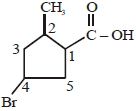
The $IUPAC$ name of the following compound is :
Of the following, the one with largest size is
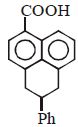
Calculate double bond equivalent in following compound.
An organic compound $C_xX_YO_z$ on complete combustion provides equivolume of products $CO_2(g)$ and $H_2O(g)$ which is individually double the volume of organic compound taken. In the process volume of oxygen consumed is same as volume of $CO_2$ produced and liberated heat during combustion is $500 \ kcal/mole$ at constant pressure and at $500\ K$. Formula of organic compoun  & $\Delta U$ for reaction will be -
Boiling point of equimolar ideal solution of hexane, $C_6H_{14}$ and heptane , $C_7H_{16}$ is $80\,^o C$. What is the boiling point of mixture of hexane and heptane containing equal mass of both. Boiling points of hexane and heptane are $69\,^o C\ \&\ 98\,^o C$ respectively -
The following two reactions are known

$Fe_2O_{3(s)} + 3CO_{(g)} \rightarrow 2Fe_{(s)} + 3CO_{2(g)};$ $\Delta H = - 26.8\, kJ$

$FeO_{(s)} + CO_{(g)} \rightarrow Fe_{(s)} + CO_{2(g)} \, ;$ $\Delta H = - 16.5\, kJ$

The value of $\Delta H$ for the following reaction

$Fe_2O_{3(s)} + CO_{(g)} \rightarrow 2FeO_{(s)} + CO_{2(g)}$ is ............. $\mathrm{kJ}$

Number of $\sigma$ and $\pi$ bonds present in ethylene molecule is respectively :