MCQ
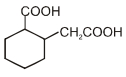
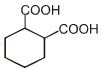
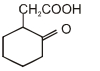
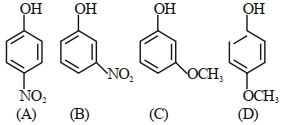
The compound that undergoes decarboxlylation most readily under mild condition is
  • A


  • C

  • D

Answer

Correct option: B.

b
In decarboxylation, $\beta$-carbon acquires $\delta$ - charge. Whenever $\delta$ - charge is stabilized, decarboxylation becomes simple. In $(B)$, it is stabilized by $- m \&- I$ of $C = O$, which is best amongst the options offered,

Need a full question paper?

Generate a complete, print-ready paper with questions like this in minutes — across 16+ boards, with answer keys.

Start Generating Free

Similar questions

Molarity of a solution prepared by dissolving $75.5\,g$ of pure $ KOH $ in $540\,ml$ solution is .......... $M$
Which of the following liberate hydrogen on reaction with dilute ${H_2}S{O_4}$
The complex(es), which can exhibit the type of isomerism shown by $\left[\mathrm{Pt}\left(\mathrm{NH}_3\right)_2 \mathrm{Br}_2\right]$, is(are) [en $=\mathrm{H}_2 \mathrm{NCH}_2 \mathrm{CH}_2 \mathrm{NH}_2$ ]

($A$) $\left[\mathrm{Pt}(\mathrm{en})(\mathrm{SCN})_2\right]$

($B$) $\left[\mathrm{Zn}\left(\mathrm{NH}_3\right)_2 \mathrm{Cl}_2\right]$

($C$) $\left[\mathrm{Pt}\left(\mathrm{NH}_3\right)_2 \mathrm{Cl}_4\right]$

($D$) $\left[\mathrm{Cr}(\mathrm{en})_2\left(\mathrm{H}_2 \mathrm{O}\right)\left(\mathrm{SO}_4\right)\right]^{+}$

The number of species below that have two lone pairs of electrons in their central atom is ..... . (Round off to the Nearest integer)

$SF _{4}, BF _{4}^{-}, CIF _{3}, AsF _{3}, PCl _{5}, BrF _{5}, XeF _{4}, SF _{6}$

Standard electrode potential for Daniell cell is 1.1 V. What will be the standard Gibbs energy for the reaction:
$Zn _{( s )}+ Cu _{( aq )}^{2+} \rightarrow Zn _{( aq )}^{2+}+ Cu _{( s )}\left( F =96487 C mol ^{-1}\right)$
Which of the following graph is correct representation between atomic number $(Z)$ and magnetic moment of $d-block$ elements? [Outer electronic configuration : $(n -1)d^x\, ns^{1\, or \,2}$]
$\begin{matrix}
   {{H}_{2}}C=CH-C{{H}_{2}}-C{{H}_{2}}-CH-C{{H}_{3}}\xrightarrow[Pyridine]{SOC{{l}_{2}}}  \\
   \,\,\,\,\,\,\,\,\,\,\,\,\,\,\,\,\,\,\,\,\,\,\,\,\,\,\,\,\,\,\,\,\,\,\,\,\,\,\,| \,\,\,\,\,\,\,\, \\
   \,\,\,\,\,\,\,\,\,\,\,\,\,\,\,\,\,\,\,\,\,\,\,\,\,\,\,\,\,\,\,\,\,\,\,\,\,\,\,\,\,\,OH\,\,\,\,\,\,  \\
\end{matrix}$  $(A)\xrightarrow[({{H}_{2}}O)]{{{O}_{3}}/Zn}\underset{{{C}_{5}}{{H}_{9}}ClO}{\mathop{(B)}}\,\xrightarrow{NaB{{H}_{4}}}(C)$

Compound $(C)$ is

Which of following can be prepared effectively by Williamson ether synthesis
Arrange the following in decreasing acidic strength.
The electronic configuration of Cu(II) is 3d9 whereas that of Cu(I) is 3d10. Which of the following is correct?