MCQ
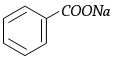
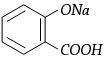
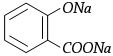
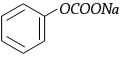
The compound $X$ in the reactionis
  • A


  • C

  • D

Answer

Correct option: B.

b
(b) It is Kolbe’s reaction.

Need a full question paper?

Generate a complete, print-ready paper with questions like this in minutes — across 16+ boards, with answer keys.

Start Generating Free

Similar questions

The major products $\mathrm{C}$ and $\mathrm{D}$ formed in the following reactions respectively are

$\mathrm{C}\mathrm{H}_{3} -\mathrm{CH}_{2}-\mathrm{CH}_{2}-\mathrm{O}-\mathrm{C}\left(\mathrm{CH}_{3}\right)_{3} \xrightarrow[\Delta]{{\mathrm{excess} \mathrm{HI}}} \mathrm{C}+\mathrm{D}$

The major product obtained on interaction of phenol with sodium hydroxide and carbon dioxide is
Functional group present in sulphonic acid is:
The correct option for the value of vapour pressure of a solution at $45^{\circ} \mathrm{C}$ with benzene to octane in molar ratio $3: 2$ is  ...... $\mathrm{mm}$ of $\mathrm{Hg}$

[At $45^{\circ} \mathrm{C}$ vapour pressure of benzene is $280\, \mathrm{~mm} \,\mathrm{Hg}$ and that of octane is $420\, \mathrm{~mm} \,\mathrm{Hg}$. Assume Ideal gas]

Which of the following alkyl groups has the maximum $+ I$ effect
When the excited electron of a $H$ atom from $n =5$ drops to the ground state, the maximum number of emission lines observed are$.......$
Based on the following thermochemical equations

${H_2}O(g) + C(s) \to CO(g) + {H_2}(g);\,\Delta H = 131\,kJ$$CO(g) + \frac{1}{2}{O_2}(g) \to C{O_2}(g);\Delta H = - 282\,kJ$

${H_2}(g) + \frac{1}{2}{O_2}(g) \to {H_2}O(g);\,\Delta H = - 242\,kJ$

$C(s) + {O_2}(g) \to C{O_2}(g);\,\Delta H = X\,kJ$ The value of $X$ is ......$kJ$

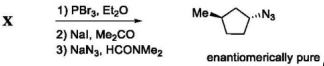
In the following reaction sequence, the correct structure($s$) of $X$ is (are)

(image)

Identify the basic amino acid
During mixed acid nitration of benzene Conc. $HNO_3$ behaves like