MCQ
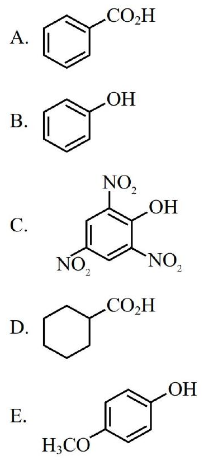
The compounds that produce $\mathrm{CO}_{2}$ with aqueous $\mathrm{NaHCO}_{3}$ solution are :

Image
Choose the correct answer from the options given below :
  • A
    A and C only
  • B
    A, B and E only
  • A, C and D only
  • D
    A and B only

Answer

Correct option: C.
A, C and D only
(C)
Sol. A, C, D produce $\mathrm{CO}_{2}$ with aqueous $\mathrm{NaHCO}_{3}$ solution.
A, C, D acids are stronger acid than $\mathrm{H}_{2} \mathrm{CO}_{3}$ (Carbonic acid)

Need a full question paper?

Generate a complete, print-ready paper with questions like this in minutes — across 16+ boards, with answer keys.

Start Generating Free

Similar questions

Of the following, the one with largest size is
Ozone with $KI$ solution produces
The following reaction occurs in the Blast furnance where iron ore is reduced to iron metal $Fe _2 O _{3(s)}+3 CO _{( g )} \rightleftharpoons Fe _{( l )}+3 CO _{2(g)}$ Using the Le chatelier's principle, predict which one of the following will not disturb the equilibrium.
Match List $I$ with List $II$.
List $I$ Reaction List $II$ Reagents
$A$ Hoffmann Degradation $I$ Conc.KOH,$\Delta$
$B$ Clemenson reduction $II$ $CHCl _3, NaOH / H _3 O ^{+}$
$C$ Cannizaro reaction $III$ $Br _2, NaOH$
$D$ Reimer-Tiemann reaction $IV$ $Zn - Hg / HCl$
Which of the following pair will have different oxidation number of oxygen ?
Consider the following reactions in which all the reactants and products are in gaseous state

${\text{2PQ}} \rightleftharpoons {{\text{P}}_2}{\text{  +  }}{{\text{Q}}_2}\,;\,\,\,\,{{\text{K}}_1}{\text{ =  2}}{\text{.5 }} \times \,{\text{1}}{{\text{0}}^5}\,$

${\text{PQ + }}\frac{1}{2}{R_2} \rightleftharpoons PQR\,;\,\,\,\,{{\text{K}}_2}{\text{ =  5 }} \times \,{\text{1}}{{\text{0}}^{ - 3}}\,$

The value of equilibrium constant for reaction

$\frac{1}{2}{{\text{P}}_2}{\text{ + }}\frac{1}{2}{{\text{Q}}_2}{\text{ + }}\frac{1}{2}{R_2} \rightleftharpoons PQR\,$ is
Which of the following compounds shows tautomerism
Total number of element in $10^{th}$ period of $P.T.$ will be
Which of the following is weakly acidic
Modern periodic table is based on the atomic number of the elements. The experiment which proved the significance of the atomic number was