MCQ
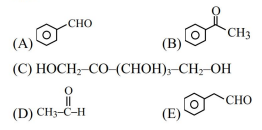
- A(A), (C) and (D) Only
- B(D) and (E) Only
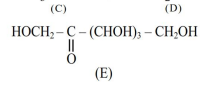
- ✓(C), (D) and (E) Only
- D(A), (B) and (C) Only
Generate a complete, print-ready paper with questions like this in minutes — across 16+ boards, with answer keys.
$\mathrm{C}_{3} \mathrm{H}_{6} \stackrel{\mathrm{H}^{+} / \mathrm{H}_{2} \mathrm{O}}{\longrightarrow} A\xrightarrow[dil.\,KOH]{KIO} B+C$
The compounds $B$ and $C$ respectively are :
${\text{2PQ}} \rightleftharpoons {{\text{P}}_2}{\text{ + }}{{\text{Q}}_2}\,;\,\,\,\,{{\text{K}}_1}{\text{ = 2}}{\text{.5 }} \times \,{\text{1}}{{\text{0}}^5}\,$
${\text{PQ + }}\frac{1}{2}{R_2} \rightleftharpoons PQR\,;\,\,\,\,{{\text{K}}_2}{\text{ = 5 }} \times \,{\text{1}}{{\text{0}}^{ - 3}}\,$
The value of equilibrium constant for reaction
$\frac{1}{2}{{\text{P}}_2}{\text{ + }}\frac{1}{2}{{\text{Q}}_2}{\text{ + }}\frac{1}{2}{R_2} \rightleftharpoons PQR\,$ is