MCQ
The compressibility of a material is
  • A
    Product of volume and its pressure
  • The change in pressure per unit change in volume strain
  • C
    The fractional change in volume per unit change in pressure
  • D
    None of the above

Answer

Correct option: B.
The change in pressure per unit change in volume strain
The fractional change in volume per unit change in pressure

Need a full question paper?

Generate a complete, print-ready paper with questions like this in minutes — across 16+ boards, with answer keys.
Start Generating Free

Similar questions

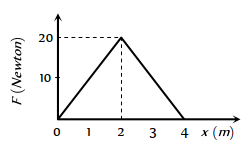
The graph between the resistive force $F$ acting on a body and the distance covered by the body is shown in the figure. The mass of the body is $25 \mathrm{~kg}$ and initial velocity is $2 \mathrm{~m} / \mathrm{s}$. When the distance covered by the body is $4 m$, its kinetic energy would be
Image
Two lenses of power $6 D$ and $-2 D$ are combined to form a single lens. The focal length of this lens will be
A galvanometer $G$ deflects full scale when a potential difference of $0.50 $ $V$ is applied. The internal resistance of the galvanometer $r_g$ is $25$ $ohms$. An ammeter is constructed by incorporating the galvanometer and an additional resistance $R_S$. The ammeter deflects full scale when a measurement of $2.0$ $A$ is made. The resistance $R_S$ is closest to : ................. $\Omega$
Long distance short-wave radio broadcasting uses
If the distance of the far point for a myopia patient is doubled, the focal length of the lens required to cure it will become
We have two (narrow) capillary tubes $T$ and $T$. Their lengths are $l$ and $I$ and radii of cross-section are $r$ and $r$ respectively. The rate of flow of water under a pressure difference $P$ through tube $T$ is $8 cm / sec$. If $I=2 l$ and $r=r$, what will be the rate of flow when the two tubes are connected in series and pressure difference across the combination is same as before $(=P)$
If a graph is plotted taking the temperature in Fahrenheit along $\gamma$ axis and the corresponding temperature in Celsius along the $X$-axis, it will be a straight line
The wavelength of $K_\alpha X$-rays produced by an $X$-ray tube is $0.76 \mathring A$. The atomic number of the anode material of the tube is
Two vibrating strings of the same material but lengths $L$ and $2 L$ have radii $2 r$ and $r$ respectively. They are stretched under the same tension. Both the strings vibrate in their fundamental modes, the one of length $L$ with frequency $n$ and the other with frequency $n$. The ratio $n / n$ is given by
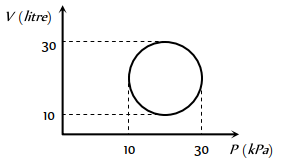
Heat energy absorbed by a system in going through a cyclic process shown in figure isImage