MCQ
The conjugate base of $N{H_2}^ - $ is
  • A
    $N{H_3}$
  • $N{H^{2 - }}$
  • C
    $NH_4^ + $
  • D
    ${N_3}^ - $

Answer

Correct option: B.
$N{H^{2 - }}$
(b) $NH_2^ -  $ $ \rightleftharpoons $ $ N{H^{ - 2}} + {H^ + }$

Conjugate acid, base pair.

Need a full question paper?

Generate a complete, print-ready paper with questions like this in minutes — across 16+ boards, with answer keys.
Start Generating Free

Similar questions

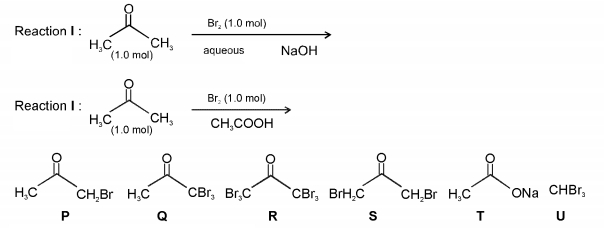
After completion of the reactions ($I$ and $II$ ), the organic compound$(s)$ in the reaction mixtures is (are)
The major products $A$ and $B$ from the following reactions are:
Given below are two statements :
Statement I : A homolepitc octahedral complex, formed using monodentate ligands, will not show stereoisomerism.
Statement II : cis- and trans- platin are heteroleptic complexes of Pd .
In the light of the above statements, choose the correct answer from the options given below.
The value of Planck's constant is $6.63 \times 10^{-34} \ J \ s.$ The speed of light is $3 \times 10^{17}\, nm\, s ^{-1}.$ Which value is closest to the wavelength in nanometer of a quantum of light with frequency of $6 \times 10^{18} s^{-1} $ ?
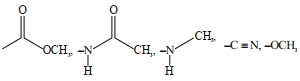
Total number of deactivating groups in aromatic electrophilic substitution reaction among the following is
An artificial cell is made by encapsulating $0.2 \mathrm{M}$ glucose solution within a semipermeable membrane. The osmotic pressure developed when the artificial cell is placed within a $0.05 \mathrm{M}$ solution of $\mathrm{NaCl}$ at $300 \mathrm{~K}$ is . . . . . . . . . .$\times 10^{-1}$ bar. (Nearest Integer)

[Given : $\mathrm{R}=0.083 \mathrm{~L} \mathrm{bar} \mathrm{mol}^{-1} \mathrm{~K}^{-1}$ ]

Assume complete dissociation of $\mathrm{NaCl}$
$\mathrm{X}$ of enthanamine was subjected to reaction with $\mathrm{NaNO}_2 / \mathrm{HCl}$ followed by hydrolysis to liberate $\mathrm{N}_2$ and $\mathrm{HCl}$. The $\mathrm{HCl}$ generated was completely neutralised by $0.2$ moles of $\mathrm{NaOH} . \mathrm{X}$ is . . . . $g$.
The enhanced force of cohesion in metals is due to
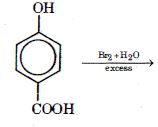
What is Product
The rate of a reaction quadruples when the temperature changes from $300$ to $310\, K$. The activation energy of this reaction is ........... $kJ\, mol^{-1}$ (Assume activation energy and pre-exponential factor are independent of temperature ; $ln\, 2\, = 0.693 ; R\, = 8.314\, J\, mol^{-1}\, K^{-1}$ )