MCQ
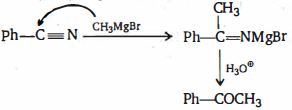
The conversion, $PhCN \to PhCOCH_3,$ can be achieved most conveniently by reaction with
- ✓$CH_3MgBr$ followed by hydrolysis
- B$I_2 - NaOH, CH_3I.$
- Cdil. $H_2SO_4$ followed by reaction with $CH_2N_2$
- D$LAH$ followed by reaction with $CH_3I$
Generate a complete, print-ready paper with questions like this in minutes — across 16+ boards, with answer keys.
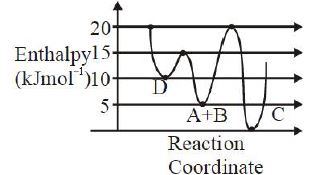
Given: $\Delta H ^0=-54.07\,kJ\,mol ^{-1}$
$\Delta S ^{\circ}=10\,JK ^{-1}\,mol ^{-1}$
(Take $2.303 \times 8.314 \times 298=5705$ )
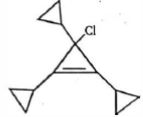
${\mathrm{C}_{2} \mathrm{H}_{5} \mathrm{OH}}{\longrightarrow} {\text { (Major product) }{ }^{\prime} \mathrm{A}^{\prime}}$
Product $A$ is :
$H _2( g )+\frac{1}{2} O _2( g ) \rightarrow H _2 O (\ell)$
The work derived from the cell on the consumption of $1.0 \times 10^{-3} mol$ of $H _2( g )$ is used to compress $1.00 mol$ of a monoatomic ideal gas in a thermally insulted container. What is the change in the temperature (in $K$ ) of the ideal gas ?
The standard reduction potentials for the two half-cells are given below.
$\left. O _2( g )+4 H ^{+} \text {(aq. }\right)+4 e ^{-} \rightarrow 2 H _2 O (\ell), E ^{\circ}=1.23 V,$
$\left.2 H ^{+} \text {(aq. }\right)+2 e ^{-} \rightarrow H _2( g ), E ^{\circ}=0.00 V.$
Use $F =96500 C mol ^{-1}, R =8.314 J mol ^{-1} K ^{-1}$