Question
The coolant used in a nuclear reactor should have high specific heat. Why?

Answer

The purpose of a coolant is to absorb maximum heat with least rise in its own temperature. This is possible only if specific heat is high because $\text{Q}=\text{mc}\Delta\text{T}.$ For a given value of m and Q, the rise in temperature $\Delta\text{T}$ will be small if c is large. This will prevent different parts of the nuclear reactor from getting too hot.

Need a full question paper?

Generate a complete, print-ready paper with questions like this in minutes — across 16+ boards, with answer keys.
Start Generating Free

Similar questions

A pendulum clock giving correct time at a place where $\mathrm{g}=9.800 \mathrm{~m} / \mathrm{s}^2$ is taken to another place where it loses 24 seconds during 24 hours. Find the value of $g$ at this new place.
The piston in the cylinder head of a locomotive has a stroke (twice the amplitude) of 1.0m. If the piston moves with simple harmonic motion with an angular frequency of 200rad/min, what is its maximum speed?
If water in one flask and castor oil in other are violently shaken and kept on a table, which will come to rest earlier?
A body has a sense of weightlessness in a satellite revolving around the earth, why?
A heavy box is kept on a smooth inclined plane and is pushed up by a force $F$ acting parallel to the plane. Does the work done by the force $F$ as the box goes from $A$ to $B$ depend on how fast the box was moving at $A$ and $B$ ? Does the work by the force of gravity depend on this?
A person sitting in a running train throws a ball vertically upwards. What is the nature of the path described by the ball to a person?
  1. Sitting inside the train.
  2. Standing on the ground outside the train.
An aeroplane's velocity is doubled. What happens to its momentum and kinetic energy?
The position of a particle is given by
$
r =3.0 t \hat{ i }+2.0 t^2 \hat{ j }+5.0 \hat{ k }
$
where $t$ is in seconds and the coefficients have the proper units for $r$ to be in metres. (a) Find $v (t)$ and $a(t)$ of the particle. (b) Find the magnitude and direction of $v (t)$ at $t=1.0 s$.
A closed and an open pipe are sounded for same frequency. What is the ratio of their lengths?
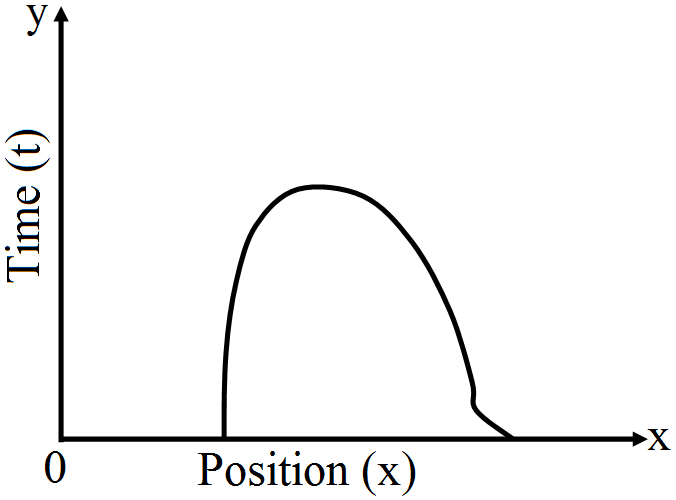
Is the time variation of position shown in figure observed in nature possible?