MCQ
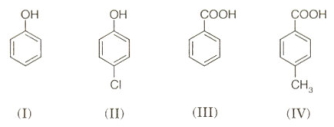
The correct acidity order of the following is
- ✓$(III) > (IV) > (II) > (I)$
- B$(IV) > (III) > (I) > (II)$
- C$(III) > (II) > (I) > (IV)$
- D$(II) > (III) > (IV) > (I)$
Carboxylic acid is more acidic than phenol. When an electron releasing group is present in the para position to $-COOH$ group in aromatic carboxylic acid, the acidity is reduced.
When $Cl$ atom is present in the para position to $-OH$ group in phenol, it increases its acidity.
Here $Cl$ atom withdraws electron density from the ring and stabilizes the phenoxide ion.
Option $A$ is correct.
Generate a complete, print-ready paper with questions like this in minutes — across 16+ boards, with answer keys.
Amongst the above molecule(s)/ion(s), the number of molecule(s)/1on(s) having $sp ^{3} d ^{2}$ hybridisation is $........$
Which of the following compounds can be $A$ ?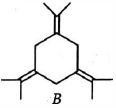
$Pt _{( s )}\left| H _2( g , 1\,atm )\right| H ^{+}( aq , 1 M )|| Fe ^{3+}( aq ), Fe ^{2+}( aq ) \mid Pt ( s )$
When the potential of the cell is $0.712\,V$ at $298\,K$, the ratio $\left[ Fe ^{2+}\right] /\left[ Fe ^{3+}\right]$ is $.......$(Nearest integer)
Given: $Fe ^{3+}+ e ^{-}= Fe ^{2+}, E ^{\circ} Fe ^{3+}, Fe ^{2+} \mid Pt =0.771$
$\frac{2.303 RT }{ F }=0.06\,V$