MCQ
The correct acidity order of the following is
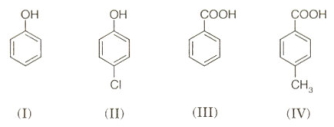
- ✓$(III) > (IV) > (II) > (I)$
- B$(IV) > (III) > (I) > (II)$
- C$(III) > (II) > (I) > (IV)$
- D$(II) > (III) > (IV) > (I)$
Carboxylic acid is more acidic than phenol. When an electron releasing group is present in the para position to $-COOH$ group in aromatic carboxylic acid, the acidity is reduced.
When $Cl$ atom is present in the para position to $-OH$ group in phenol, it increases its acidity.
Here $Cl$ atom withdraws electron density from the ring and stabilizes the phenoxide ion.
Option $A$ is correct.
Generate a complete, print-ready paper with questions like this in minutes — across 16+ boards, with answer keys.
$I.$ There is no $P_{\pi } -P_{\pi }$ bonds present in the molecule
$II.$ There are eight lone pair of electrons
$III.$ Each $S$ atom is $sp^3$ hybridised
(Rounded off to the nearest integer)
[Given $: E_{Z n^{+2}/Z_{n}}^{0}=-0.76 \,V ; E _{A g^{+} / A_{ g }}^{0}=+0.80 \,V ; \frac{2.303 RT }{ F }=0.059$]
