MCQ
The correct formula to determine Youngs Modulus of elasticity will be:
  • A
    $Y =\frac{ Mgl }{\pi r^2 L}$
  • B
    $Y =\frac{ Mg }{\pi r^2 L}$
  • $Y =\frac{ MgL }{\pi r^2 l}$
  • D
    $Y =\frac{ Mg r^2}{\pi L l}$.

Answer

Correct option: C.
$Y =\frac{ MgL }{\pi r^2 l}$
C

Need a full question paper?

Generate a complete, print-ready paper with questions like this in minutes — across 16+ boards, with answer keys.
Start Generating Free

Similar questions

The time period of a seconds pendulum is $2\, sec$. The spherical bob which is empty from inside has a mass $50\; gram$, this now is replaced by another solid of same radius but have different mass of $100\; gram$. The new time period will be ..... $\sec$
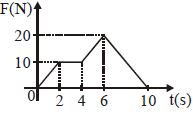
A particle of mass $2\, kg$ is initially at rest. A force acts on it whose magnitude changes  with time. The force time graph is shown below. The velocity of the particle after $10\, s$ is ......... $ms^{-1}$
Consider the equations $\text{P}=\lim_\limits{\triangle\text{s}\rightarrow0}\frac{\text{F}}{\triangle\text{s}}$ and $\text{P}_1-\text{P}_2-\text{pgz}$ In an elevator accelerating upward.
 
The speed of sound in a gas, in which two waves of wavelength $1.0\,\, m$ and $1.02\,\, m$ produce $6$ beats per second, is approximately .... $m/s$
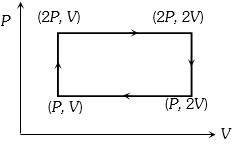
Work done in the given $P-V$ diagram in the cyclic process is
An air bubble of volume $v _0$ is released by a fish at a depth $h$ in a lake. The bubble rises to the surface. Assume constant temperature and standard atmospheric pressure above the lake. The volume of the bubble just before touching the surface will be (density) of water is $\rho$
Two moles of ideal helium gas are in a rubber balloon at $30^{\circ} C$. The balloon is fully expandable and can be assumed to require no energy in its expansion. The temperature of the gas in the balloon is slowly changed to $35^{\circ} C$. The amount of heat required in raising the temperature is nearly (take $R =8.31 J / mol$. $K$)
A shell of mass $m$ is at rest initially. It explodes into three fragments having mass in the ratio $2: 2: 1$. If the fragments having equal mass fly off along mutually perpendicular directions with speed $v$, the speed of the third (lighter) fragment is :
A beam of metal supported at the two ends is loaded at the centre. The depression at the centre is proportional to
A diatomic molecule has how many degrees of freedom: