MCQ
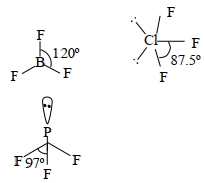
The correct increasing order for bond angles among $\mathrm{BF}_3, \mathrm{PF}_3$ and $\mathrm{C} / \mathrm{F}_3$ is :
  • A
     $\mathrm{PF}_3<\mathrm{BF}_3<\mathrm{C} \ell \mathrm{F}_3$
  • B
     $\mathrm{BF}_3<\mathrm{PF}_3<\mathrm{C} / \mathrm{F}_3$
  • $\mathrm{C} / \mathrm{F}_3<\mathrm{PF}_3<\mathrm{BF}_3$
  • D
     $\mathrm{BF}_3=\mathrm{PF}_3<\mathrm{C} \ell \mathrm{F}_3$
Answer

Correct option: C.
$\mathrm{C} / \mathrm{F}_3<\mathrm{PF}_3<\mathrm{BF}_3$
c
$Image$

Order of bond angle is

$\mathrm{ClF}_3<\mathrm{PF}_3<\mathrm{BF}_3$

Need a full question paper?

Generate a complete, print-ready paper with questions like this in minutes — across 16+ boards, with answer keys.

Start Generating Free

Similar questions

The less reactivity of chlorine atom in $C{H_2} = CH - Cl$ is due to
Silver sulphide dissolved in a solution of sodium cynamide to form the complex
Which of the following orders is correct for heat of hydrogenation of these compounds ?
Which of the following is a polar molecule ?
Given below are two statements :
Statement (I) : The first ionisation enthalpy of group 14 elements is higher than the corresponding elements of group 13.
Statement (II) : Melting points and boiling points of group 13 elements are in general much higher than those the corresponding elements of group 14 . In the light of the above statements, choose the most appropriate answer from the options given below :
Some amount of dichloromethane $\left( CH _2 Cl _2\right)$ is added to $671.141\,mL$ of chloroform $\left( CHCl _3\right)$ to prepare $2.6 \times 10^{-3}\,M$ solution of $CH _2 Cl _2( DCM )$. The concentration of $DCM$ is $.........ppm$ (by mass).Given: Atomic mass : $C =12 ; H : 1 ; Cl =35.5$ density of $CHCl _3=1.49\,g\,cm ^{-3}$
If $D_T$ and $D_0$ are the theoretical and observed vapour densities at a definite  temperature and $\alpha$ be the degree of dissociation of a substance. Then, $\alpha$ in  the terms of $D_0, D_T$ and $n$ (number of moles of product formed from $1 \,mole$ reactant) is calculated by the formula
Types of geometrical isomerism shown at point $X, Y$ and $Z$ of the following compound respectively are

$X-Y-Z$

Image
This reduction reaction is known as:
Select correct statement about hydrolysis of $BCl_3$ and $NCl_3$