MCQ
The correct $IUPAC$ name for the below compound is
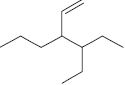
  • $4-$ethyl$-{3-}$propylhex$-1-$ene
  • B
    ${3-}$ethyl${-4}-$ethenylheptane
  • C
    ${3-}$ethyl${-4}-$propylhex${-5}-$ene
  • D
    ${3-}(1-$ethylpropyl$)$hex$-1-$ene.

Answer

Correct option: A.
$4-$ethyl$-{3-}$propylhex$-1-$ene
a
First longest chain carbon is chosen that include alkene with less number according to $IUPAC$ convention.

$4-$ ethyl $-{3-}$ propylhex $-1-$ ene

Need a full question paper?

Generate a complete, print-ready paper with questions like this in minutes — across 16+ boards, with answer keys.

Start Generating Free

Similar questions

In a closed container of $1000\, cm^3$, $2\, mol\, PCl_5$, $2\, mol\, PCl_3$ and $3\, mol\, Cl_2$ are found to be at equilibrium at $27\,^oC$. Then $K_P$ for $PCl_5(g)  \rightleftharpoons  PCl_3(g) + Cl_2(g)$ at $27\,^oC$ is .....$ atm$
Among the following oxides, which has the maximum lattice energy?
Methyl group attached to benzene can be oxidised to carboxyl group by reacting with
If osmotic pressure of a solution is $2\,atm$ at $273\,K$, then at $546\,K$, the osmotic pressure is ........... $atm.$
$A + 2B \to C$, the rate equation for this reaction is given as Rate $= K[A][B]$ . If the concentration of $A$ is kept the same but that of $B$ is doubled what will happen to the rate it self ?
$R - X + NaN{O_2} \to P + NaX$

$R - X + AgN{O_2} \to Q + AgX$

$P$ and $Q$ are related as

Match List$-I$ with List$-II$

List$-I$ Test/Reagents/Observation(s) List$-II$ Species detected
$(a)$ Lassaigne's Test $(i)$ Carbon
$(b)\;Cu ( II )$ oxide $(ii)$ Sulphur
$(c)$ Silver nitrate $(iii)\;N , S , P ,$ and halogen
$(d)$ The sodium fusion extract gives black precipitate with acetic acid and lead acetate $(iv)$ Halogen Specifically

The correct match is

Given below are two statements: one is labelled as Assertion $(A)$ and the other is labelled as Reason $(R)$.

Assertion $(A)$: Cis form of alkene is found to be more polar than the trans form

Reason $(R)$: Dipole moment of trans isomer of $2$-butene is zero.

In the light of the above statements, choose the correct answer from the options given below :

The most appropriate reagent for conversion of $C _{2} H _{5} CN$ into $CH _{3} CH _{2} CH _{2} NH _{2}$ is
The osmotic pressure of a decinormal solution of $BaC{l_2}$ in water is